By any standard, it was a pretty smooth sales job. In early December 1920, little Nina Treutel of Vesper, Wisconsin, was writing one of her regular letters to her Aunt Emma (Treutel) Carlin. After some regular business, the 6-year-old slipped in a postscript in hopes it would help her obtain a treasured toy doll.
“Oh! Yes Aunt Emma I have 23¢ cents all saved up ready for that dolly,” Nina wrote. (A cute aside: the cents sign was written backwards.) “Just think Aunt Emma, Uncle Oscar said I could have it for $1.50¢.” (Backwards dollar and cents signs.)
One can just imagine in that little girl’s mind, Aunt Emma was just waiting to learn of the 23 cents to seal the whole deal. Maybe even in time for Christmas 1920! It reminds me of the 1983 film, A Christmas Story,in which a young boy works on his own marketing pitch to obtain a Red Ryder carbine action 200-shot range model air rifle. Set in the 1940s in small-town Indiana, much of the plot revolves around little Ralphie’s efforts to get that rifle for Christmas only to be told by various adults, “You’ll shoot your eye out.”
Nina Treutel (right) with brother Marvin (left), baby sister Elaine and older sister Ruby, circa 1922.
In the film, Ralphie gets his rifle, but we don’t know if Nina ever got that cherished dolly. It’s logical to assume she not only wrote her letter of suggestion, but perhaps augmented it with some face-to-face discussion with dear Aunt Emma and her brother, Uncle Oscar Treutel. You will get good odds if, like me, you believe Nina got her dolly.
Aunt Emma Carlin was a favorite of all the children in the Treutel/Hanneman families. She was the second-youngest child of Philipp and Henrietta Treuel. Her family moved to Vesper in 1900 after the death of her father. Emma was a prolific letter writer and kept a detailed scrapbook from which this letter came.
Nina Treutel grew up and married Lawrence Wilson. They spent most of their married life in Waukegan, Illinois, for a time operating a small grocery store detailed elsewhere on this blog. She was one of the younger sisters of my grandmother, Ruby (Treutel) Hanneman. Nina died in 2005 in Arizona.
Perhaps the most charming part of that 1920 letter came before the sales pitch for the dolly. “Why didn’t you come down Sunday?” she wrote. “Well I must shut up because pa wants to close his letter with love from mama.”
Oral history is one of the most important arrows in the historian’s quiver. Source documents, photographs, databases and the like offer their own advantages, but audio and/or video interviews deliver information not available with other types of media.
It’s one thing to read about someone and the details of their life. But being able to hear them tell the stories in their own words and voice adds immeasurably to the picture. Hearing the richness of their voice, the style of speaking, the accent; it makes them present in a way not possible with documents. This is why I so strongly recommend families conduct oral history interviews with parents, grandparents and other key relatives. Get the kids involved!
Most people love talking about their experiences growing up, so oftentimes there are no problems getting a willing “victim” to participate. However, sometimes a person is hesitant to be interviewed, especially if the topic…
Some of the most memorable images in our archive are old black-and-white photographs that were hand tinted to add color to parts of or the entire photo. Color film eliminated the novelty of that practice. Today we can do the process in reverse to create special, stunning images from even ordinary color prints.
A couple of years ago, I created a hardcover photo book for my three children, made up largely of black-and-white images with the color “repainted” onto key parts of the subject. This is made refreshingly simple with a very affordable app called ColorStrokes from Macphun Software. Available for iPad, iPhone and the Mac, ColorStrokes makes it fun and easy to “color splash” your photos. You can use the native color of the photos, or create new colors and apply them to the images.
ColorStrokes basically converts your color images to monochrome, then allows you to paint the…
MILWAUKEE, Wisconsin —Lillian G. Graef’s infectious smile and carefree demeanor belied the troubles she’d seen in her 19 years. Her 47-year-old mother, Mary, died of tuberculosis in January 1922 when Lillian was just 14. Her sister, Adeline, died in July 1921 of the same disease. The family’s oldest girl, Marie, became a surrogate mother to the rest of the children for a number of years until she too, was diagnosed with tuberculosis and forced into a sanitarium.
A graduate of SS Peter and Paul Catholic School, Lillian had a good job at a Third Street candy shop where she was a popular employee. Her best friend was Frances Platt. From the days they played with dolls together to more recent times when they borrowed each other’s clothes, Lillian and Frances were inseparable. They went to dances and movies together, and spent countless hours at…
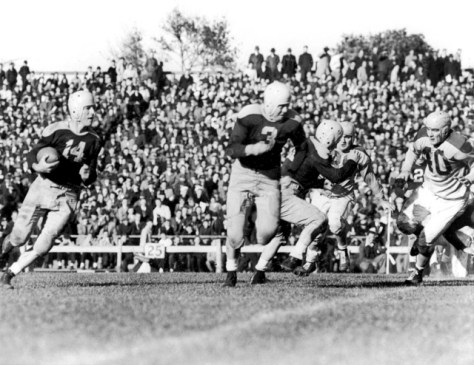
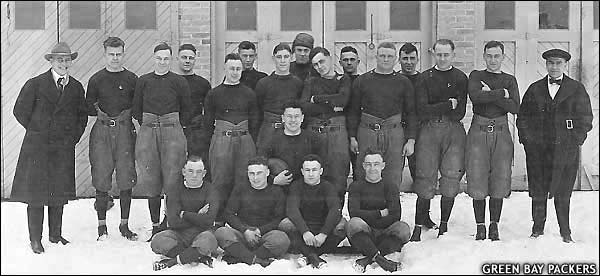
Before the Green Bay Packers could conquer the world, first they had to best the state of Wisconsin and parts of Michigan, Minnesota and Illinois. In their first two seasons, before joining what later became the National Football League, the Packers battled the Laphams from Milwaukee, the Oshkosh Professionals and the Stambaugh Miners from Michigan.
The 1919 Green Bay Packers, sponsored by the Indian Packing Co. of Green Bay. (Wikipedia)
In their first two seasons, the only team to beat them was a scrappy factory-backed team from Beloit called the Fairies. Make no mistake, the Beloit gridiron 11 was no group of winged waifs with pixie dust and a magic wand. Named for the Fairbanks Morse & Company, the Fairies handed the storied Packers franchise its first-ever loss in the fall of 1919. The game was decided on the last play and nearly caused a riot at Beloit’s Fairbanks-Morse Field.
The Auckland War Memorial Museum in New Zealand has just digitized and published an amazing collection of photographs of United States servicemen who were stationed at Warkworth in northern New Zealand during World War II. The museum is asking for help from Americans to identify the service members.
Nearly 1,100 images can be viewed on the museum’s web site. They were taken by local photographer Tudor Collins. Some of the images appear to be servicemen from other countries, but many if not most of them are of U.S. soldiers, sailors and Marines. Collins, himself a petty officer in the Royal New Zealand Navy, had a knack for putting his visitors from America at ease. It shows in the photographs.
New Zealand was a major staging and training area for U.S. forces that later attacked Guadalcanal, Tarawa and other key Japanese-held locations during the Pacific war. It also served as an exotic locale where…
Doing research on family history is an exciting journey. That is the whole idea behind Treasured Lives, a small business dedicated to helping you map out and progress on your history journey. We invite all of the readers of the Hanneman Archive to visit and follow Treasured Lives.
There are lots of online databases and services out there dedicated to genealogy and history. If that all seems overwhelming to you, Treasured Lives is a good place to start. If you’ve started your research and need a boost from a professional researcher, Treasured Lives is also for you. Even if you’re an expert and want to put some more brawn behind your projects, we can help.
We not only offer a full-range of services, but we will also deliver interesting, useful content on our blog. We specialize in:
Genealogy Research
Biographical Writing
Photo Restoration & Retouching
Tribute Videos
Oral History
Gravestone Preservation
Collections Care
Photography
Treasured Lives grew out of a love for history. Joe Hanneman, our chief researcher and owner, has been doing genealogy research for more than a decade. He runs the popular Hanneman Archive web site, and has been a professional writer and communicator for more than 30 years. In 2010, he published his first book, The Journey Home: My Father’s Story of Cancer, Faith and Life-Changing Miracles. His first history project was helping his father start piecing together his family roots from Germany and Pomerania. That grew into a major undertaking. The Hanneman Archive holds more than 15,000 images and thousands of historic documents.
History is a journey and an ever-changing destination. As we like to say, every story deserves a voice, and a champion. We are here to be your partner in history.
More than 15,000 Catholic soldiers, along with friends and relatives, took part in a May 1918 field Mass at Camp Dix at which they heard the president of Fordham University declare the Allies would win World War I because “God wills it.”
I don’t recall exactly where I obtained my photo of this incredible event. Nor do I know how the photo was captured. The panoramic view made for a photo print that is easily 3 feet wide. It stretches from the Knights of Columbus hospitality hall all the way to the end of the crowd.
More than 15,000 Catholic soldiers and their families took part in a field Mass at Camp Dix.
Held on the parade grounds of Camp Dix, N.J., the Mass was read by Father Patrick J. Hayes, who would later become a cardinal and archbishop of New York. Mass included a patriotic sermon by Rev. Dr. Joseph A. Mulry S.J. of Fordham University. “Dr. Mulry assailed the slacker who uses religion as a cloak for his cowardice,” wrote The New York Times. “He declared it was not only the country that is calling the men of the fighting nations, but God also.”
“We must not enjoy a dishonorable peace,” Mulry said. “Go forth, Christian men, to aid the boys who are in the trenches. They are holding them for you. Victory will come. God wills it.”
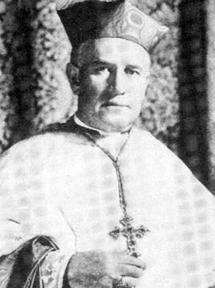
Bishop (later Cardinal) Patrick J. Hayes said Mass at the Camp Dix parade grounds in May 1918.
Mulry had long supported the Allied war against Germany. At a Knights of Columbus field Mass in May 1915, Mulry said 20 million Catholic men were prepared to back President Woodrow Wilson should the United States join the war. His sermon stressed the idea of a patriotic Catholic, something that was often under attack by Protestants.
“The Catholic of today puts into the state not the wavering intellectual culture of Athens, not the physical splendor of Rome, nor the deadly energies fostered by materialistic evolution,” Mulry said. “Not the ungodly tendencies of modern mechanical idealists, but the undying strength featured by the brotherhood of man and the fatherhood of God.”
“If the crisis were to come today, the Knights of Columbus would be the first to rally to the flag,” The New York Times wrote, quoting Mulry. While he gets his religion from Rome, Mulry told the gathering, “the Catholic soldier will lay down his life for his country and as he clasps the cross in his hands, his heart blood will ebb for faith, for country and for God.”
Soldiers take advantage of free newspapers, candies and other personal items at a WWI Knights of Columbus hut. (Library of Congress)
The Knights of Columbus put its young men up to fight, but that was only part of the expansive, unprecedented war work carried out by the K of C locally and abroad between 1917 and 1921. The Order pledged an initial $1 million to establish a war relief fund. The money helped establish a vast network of more than 300 war relief centers in the U.S. and across combat zones in Europe. These Knights of Columbus “huts” offered a place to unwind, but also supplied soldiers with scarce creature comforts like chocolates, cigarettes, candies and hot chocolate. (The large K of C hut at Camp Dix is visible at left in the panoramic photo.) Soldiers from many countries and religious denominations came to know the K of C emblem as a welcome sight. Each K of C war center hung a prominent sign for all to see: “Everyone Welcome. Everything Free.” The nickname “Casey” became synonymous with the Knights of Columbus staff at the relief centers. A typical soldier’s response upon meeting a K of C worker was, “Hello, Casey. Have you got any chocolates and doughnuts?”
Father Mulry attempted twice to retire from his job at Fordham so he might go to France and enter war work. On the third attempt in 1919, he did retire from his post at Fordham. He was so anxious to go overseas that he offered to pay $5,000 a year toward the salary of his successor. He died in Philadelphia in August 1921 at age 47 after a long illness.Two of his brothers were also priests. His other brother, Thomas M. Mulry, was a bank president, philanthropist and 1912 winner of the Laetare Medal from the University of Notre Dame.
Sadly, Father Mulry’s patriotism isn’t always remembered fondly. Fordham University’s archivist in 2014 described Mulry as “sort of a warmonger” whose speeches did not sound like those of a Catholic priest. The patriotic fervor in his talks, she contended, “was all for image.” This modern attitude fails to appreciate the deeply held patriotic views of many priests during World War I. Men like Father Raymond Mahoney, former pastor of St. Rose Catholic Church in Racine, Wisconsin. Father Mahoney was known for his patriotic sermons, including a memorable talk on liberty and the American flag. That will be the subject of a forthcoming article.





 The 1919 Green Bay Packers, sponsored by the Indian Packing Co. of Green Bay. (Wikipedia)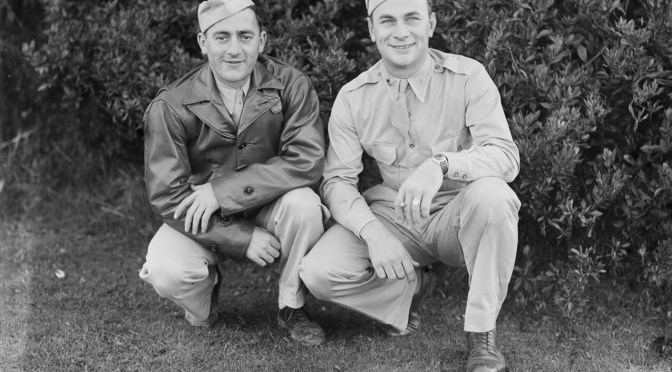




 The Hanneman Archive