Hanneman Farm in the Library of Congress

Nestled within the two dozen photo collections in the Library of Congress American Memory project is an image of grain threshing on a Hanneman farm in central Nebraska in the opening years of the 20th century.

Work on the grain threshing stopped just long enough for the farm laborers to pose for a photograph taken by Solomon D. Butcher. The caption reads: “Threshing crew on farm of E.F. Hanneman, Watertown, Buffalo County, Nebraska.” The year was 1903. The image was submitted to the Library of Congress by the Nebraska State Historical Society. 

A cropped section of the Library of Congress photo. It might be Ernest Hanneman standing at center.
A cropped section of the Library of Congress photo. It might be Ernest Hanneman at center.

The glass-plate negative photo is interesting for several reasons. One is the hand-drawn accents, such as the smoke coming from the steam engine and the straw pouring from the chute of the thresher. In the age of Adobe Photoshop and digital photo manipulation, these details might cause a chuckle. The “smoke” hardly looks real. But these details are charming nonetheless, a look at how photographers created detail and motion in photographs of that era.
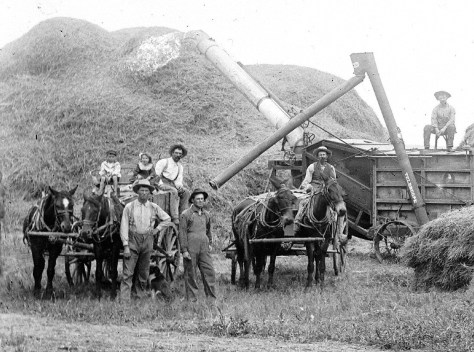
Another detail section of the Library of Congress image. Note the hand-drawn grain coming from the thresher chute.

The photo is not only of a Hanneman family farm, but it also has ties to Wisconsin. The “E.F. Hanneman” mentioned in the caption refers to Edward F. Hanneman, who lived much of his life in Buffalo County, Nebraska. Edward was born in Wisconsin in October 1880, presumably in Columbia County north of Madison. His family lived there for a time before moving west to Nebraska.

Ernest and Maria Hanneman from FindAGrave.com (submitted by Charmaine Becker).
Ernest and Maria Hanneman photo  from FindAGrave.com (submitted by Charmaine Becker).

Edward’s father, Ernest Ludwig Friedrich Hanneman, was born in Pomerania in 1843. He came to America in 1861. Ernest’s parents, Dietrich and Maria Hanneman, settled in Columbia County, but had both died by 1880. Dietrich and Maria are buried in Hillside Cemetery in Columbus, Wis. By the time of the 1900 U.S. Census, the Ernest Hanneman family had settled in Amanda Township in Buffalo County, Nebraska.

We’ve noted on these pages before that Columbia County, Wisconsin, was one of the Wisconsin Hanneman enclaves in the late 1800s. There were others in Dane, Fond du Lac, Dodge, Marathon, Wood, Portage, Racine, Winnebago and Outagamie counties. My Hanneman line settled in Portage and Wood counties, starting in 1861. There could be a connection between the Dietrich Hanneman line and my line (Matthias Hanneman, 1794-1879). More research is needed.

Many, if not most, of the Hannemans who settled the U.S. Midwest in the 1800s came from the Duchy of Pomerania, a long-ago Baltic state which is now part of Poland and Germany. My family line goes back to at least 1550 in Kreis (county) Regenwalde, Pomerania. Some of the Marathon County Hannemans moved west and settled in Lake County, South Dakota. Some Hannemans who emigrated to Wisconsin later settled in Minnesota, Iowa, South Dakota, North Dakota and Nebraska.

The American Memory project was one of the Library of Congress’ early efforts to digitize some 5 million images from its trove of priceless photographs. It invited submissions from libraries and historical societies around the nation. The Edward F. Hanneman farm photo was part of the collection “Prairie Settlement: Nebraska Photographs and Family Letters.”

©2016 The Hanneman Archive

23 Cents Toward a Cherished Doll

By any standard, it was a pretty smooth sales job. In early December 1920, little Nina Treutel of Vesper, Wisconsin, was writing one of her regular letters to her Aunt Emma (Treutel) Carlin. After some regular business, the 6-year-old slipped in a postscript in hopes it would help her obtain a treasured toy doll.

“Oh! Yes Aunt Emma I have 23¢ cents all saved up ready for that dolly,” Nina wrote. (A cute aside: the cents sign was written backwards.) “Just think Aunt Emma, Uncle Oscar said I could have it for $1.50¢.” (Backwards dollar and cents signs.)

One can just imagine in that little girl’s mind, Aunt Emma was just waiting to learn of the 23 cents to seal the whole deal. Maybe even in time for Christmas 1920! It reminds me of the 1983 film, A Christmas Story, in which a young boy works on his own marketing pitch to obtain a Red Ryder carbine action 200-shot range model air rifle. Set in the 1940s in small-town Indiana, much of the plot revolves around little Ralphie’s efforts to get that rifle for Christmas only to be told by various adults, “You’ll shoot your eye out.”

Four Treutel Siblings
Nina Treutel (right) with brother Marvin (left), baby sister Elaine and older sister Ruby, circa 1922.

In the film, Ralphie gets his rifle, but we don’t know if Nina ever got that cherished dolly. It’s logical to assume she not only wrote her letter of suggestion, but perhaps augmented it with some face-to-face discussion with dear Aunt Emma and her brother, Uncle Oscar Treutel. You will get good odds if, like me, you believe Nina got her dolly.

Aunt Emma Carlin was a favorite of all the children in the Treutel/Hanneman families. She was the second-youngest child of Philipp and Henrietta Treuel. Her family  moved to Vesper in 1900 after the death of her father. Emma was a prolific letter writer and kept a detailed scrapbook from which this letter came.

Nina Treutel grew up and married Lawrence Wilson. They spent most of their married life in Waukegan, Illinois, for a time operating a small grocery store detailed elsewhere on this blog. She was one of the younger sisters of my grandmother, Ruby (Treutel) Hanneman. Nina died in 2005 in Arizona.

Perhaps the most charming part of that 1920 letter came before the sales pitch for the dolly. “Why didn’t you come down Sunday?” she wrote. “Well I must shut up because pa wants to close his letter with love from mama.”

©2016 The Hanneman Archive

Wedding Photo Draws a Following, 90 Years Later

I’m generally not a fan of social media page “likes” or shares or fan praise. While it is one metric of success in the online world, it also can set us up for easy disappointment. That being said, I was quite pleased to see my grandparents’ wedding photo draw such nice comments on an Instagram page dedicated to preserving the stories behind photos.

Saving Family Photos featured this 1925 wedding portrait today, along with the newspaper story published shortly after the marriage of Carl F. Hanneman and Ruby V. Treutel. As of this writing (less than one full day on display), the photo has 1,016 likes. A sampling of the viewer comments:

I have a similar picture of my grandparents. You’ve inspired me to frame it.”

“Wow! Beautiful picture!”

“A true treasure.”

“Stunning photo. Love every detail. A gift for you to have this.”

“Can’t love this enough…still looking for photos of my grandparents weddings.”

“That is now may favorite wedding photo! What a treasure!”

I submitted the photo to Saving Family Photos from Treasured Lives, our sister site. If you are on Instagram, find them @savefamilyphotos. You can also see the gallery on their web site.

©2016 The Hanneman Archive

Preserve Oral History, While You Can

Joe Hanneman's avatarTreasured Lives

Oral history is one of the most important arrows in the historian’s quiver. Source documents, photographs, databases and the like offer their own advantages, but audio and/or video interviews deliver information not available with other types of media.

It’s one thing to read about someone and the details of their life. But being able to hear them tell the stories in their own words and voice adds immeasurably to the picture. Hearing the richness of their voice, the style of speaking, the accent; it makes them present in a way not possible with documents. This is why I so strongly recommend families conduct oral history interviews with parents, grandparents and other key relatives. Get the kids involved!

Most people love talking about their experiences growing up, so oftentimes there are no problems getting a willing “victim” to participate. However, sometimes a person is hesitant to be interviewed, especially if the topic…

View original post 377 more words

Color Splash Your Photo Library

Joe Hanneman's avatarTreasured Lives

Some of the most memorable images in our archive are old black-and-white photographs that were hand tinted to add color to parts of or the entire photo. Color film eliminated the novelty of that practice. Today we can do the process in reverse to create special, stunning images from even ordinary color prints.

A couple of years ago, I created a hardcover photo book for my three children, made up largely of black-and-white images with the color “repainted” onto key parts of the subject. This is made refreshingly simple with a very affordable app called ColorStrokes from Macphun Software. Available for iPad, iPhone and the Mac, ColorStrokes makes it fun and easy to “color splash” your photos. You can use the native color of the photos, or create new colors and apply them to the images.

ColorStrokes basically converts your color images to monochrome, then allows you to paint the…

View original post 121 more words

1927 Lillian Graef Killing Still Haunts Milwaukee

Joe Hanneman's avatarTreasured Lives

By Joe Hanneman
©2016 Treasured Lives

MILWAUKEE, Wisconsin —Lillian G. Graef’s infectious smile and carefree demeanor belied the troubles she’d seen in her 19 years. Her 47-year-old mother, Mary, died of tuberculosis in January 1922 when Lillian was just 14. Her sister, Adeline, died in July 1921 of the same disease. The family’s oldest girl, Marie, became a surrogate mother to the rest of the children for a number of years until she too, was diagnosed with tuberculosis and forced into a sanitarium.

A graduate of SS Peter and Paul Catholic School, Lillian had a good job at a Third Street candy shop where she was a popular employee. Her best friend was Frances Platt. From the days they played with dolls together to more recent times when they borrowed each other’s clothes, Lillian and Frances were inseparable. They went to dances and movies together, and spent countless hours at…

View original post 2,348 more words