Tag Archives: Racine

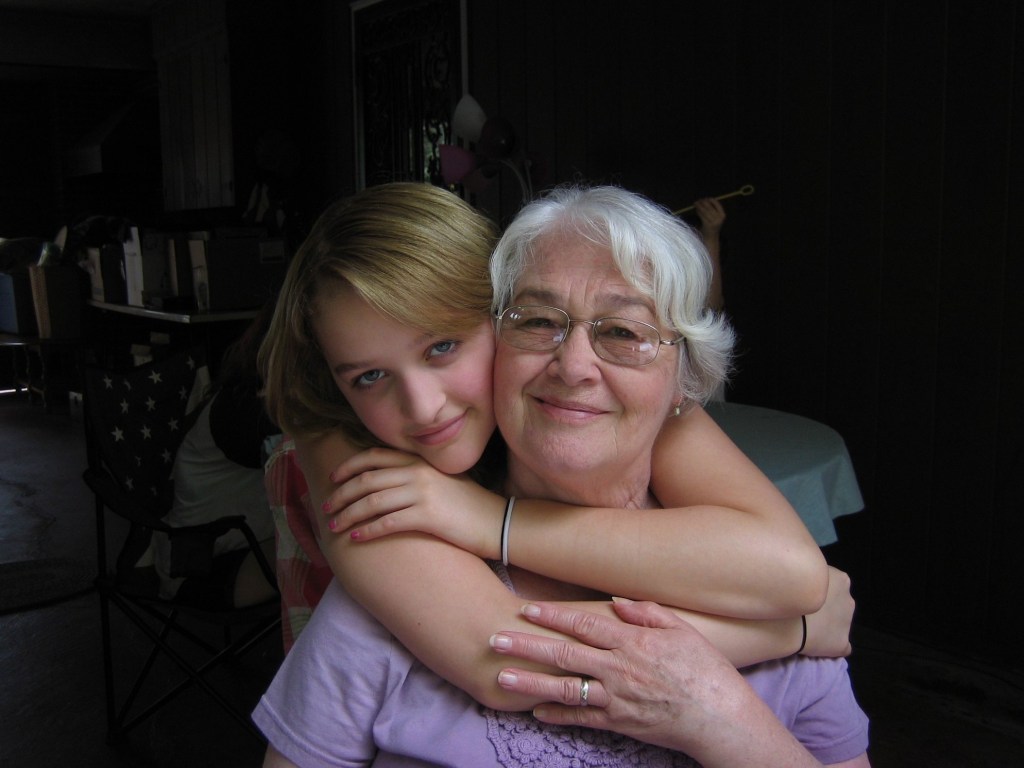
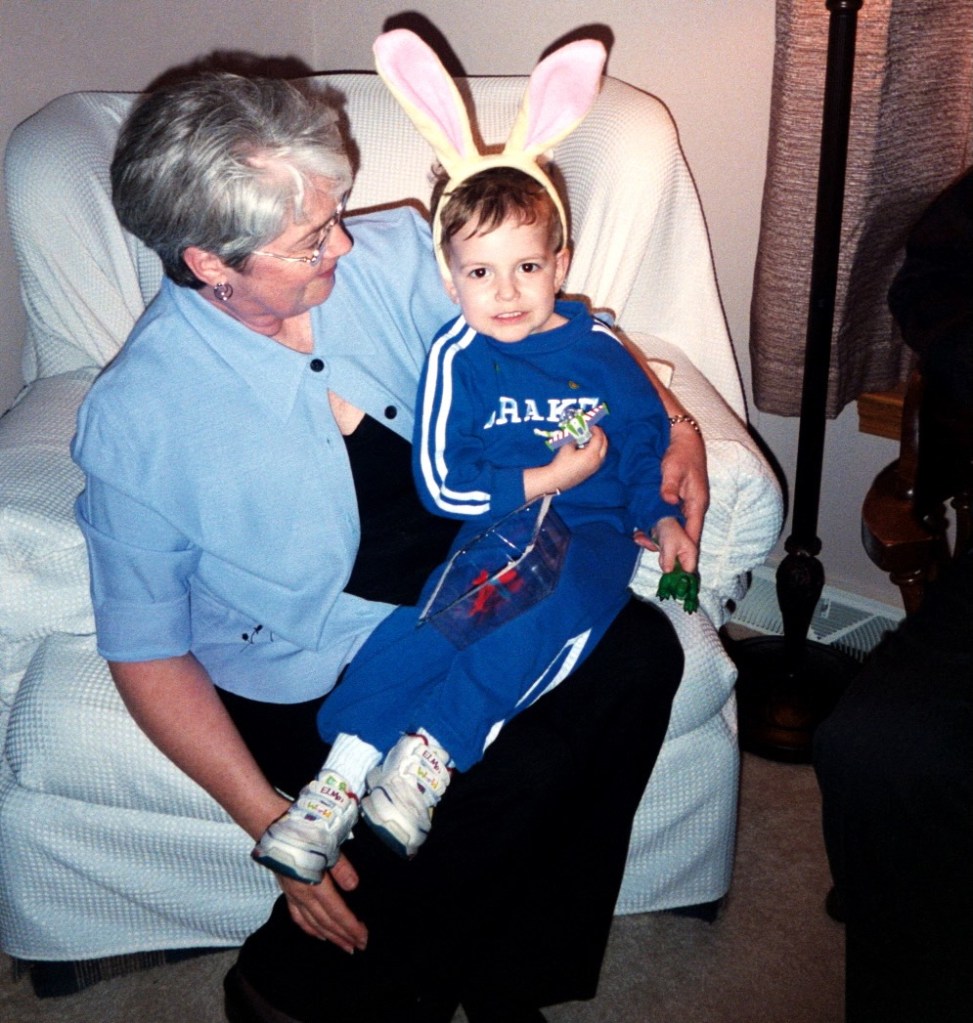
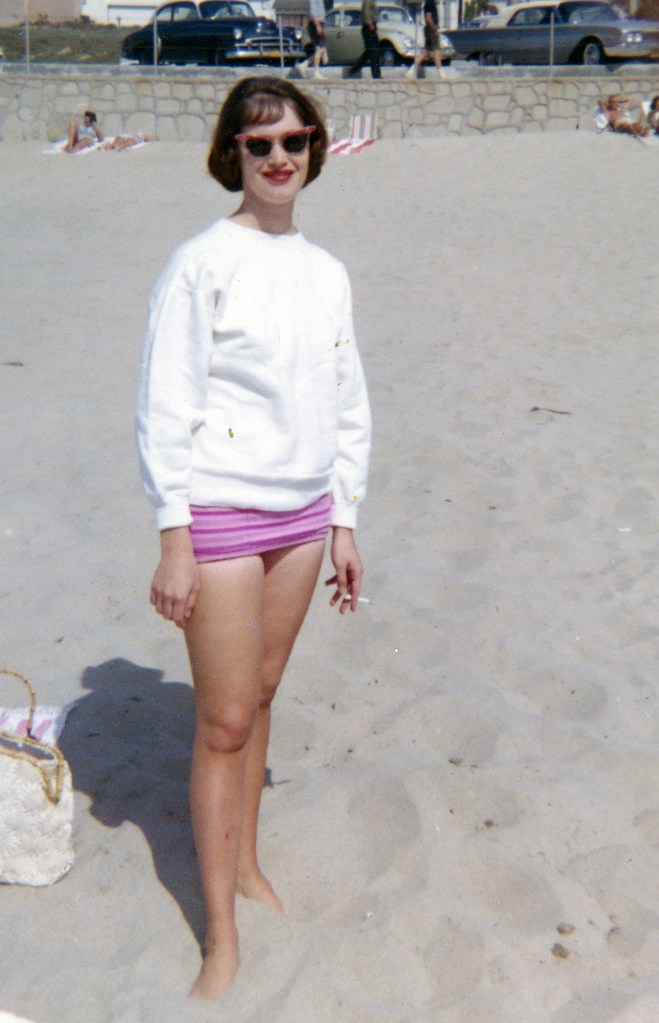
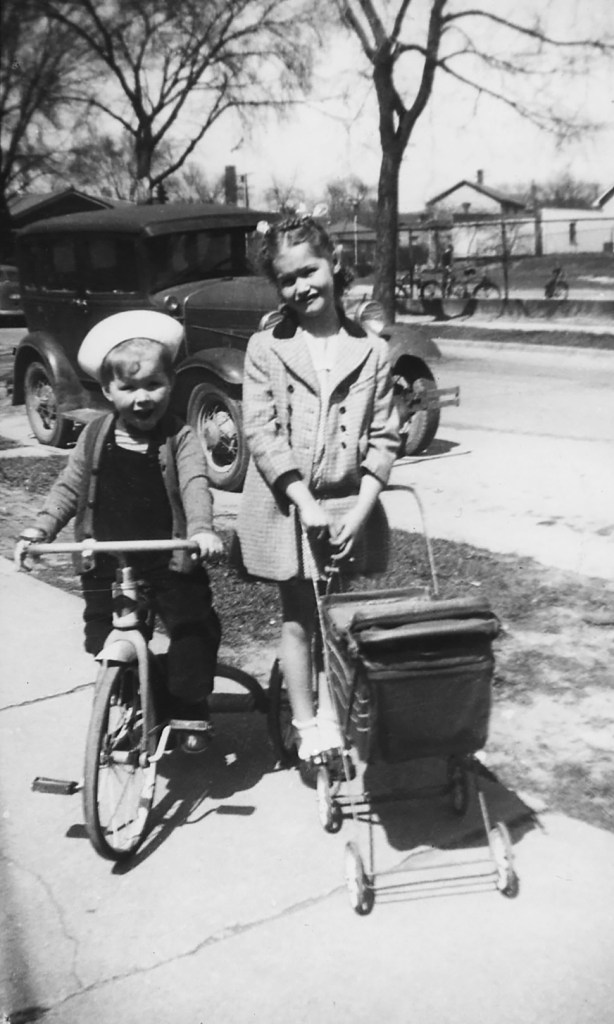
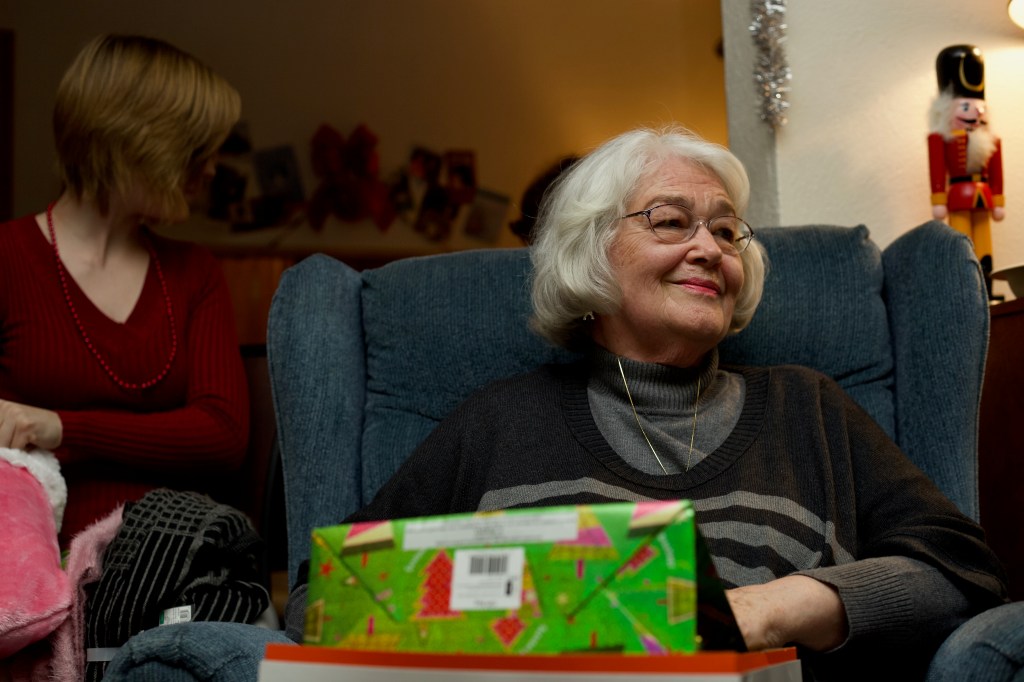
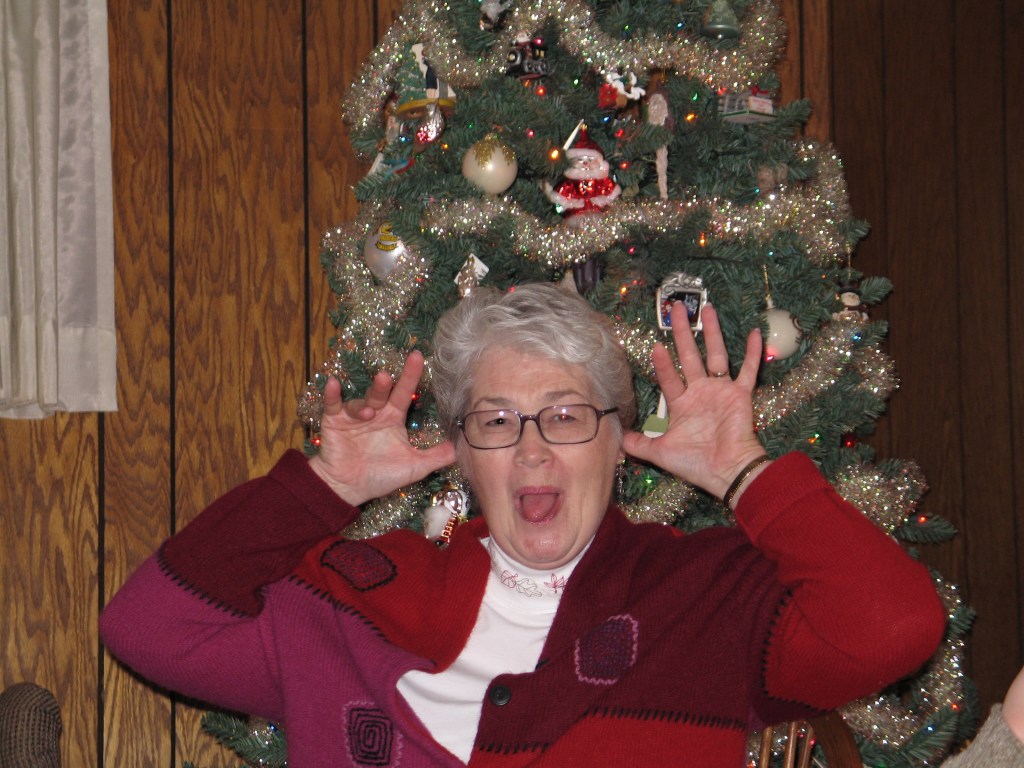
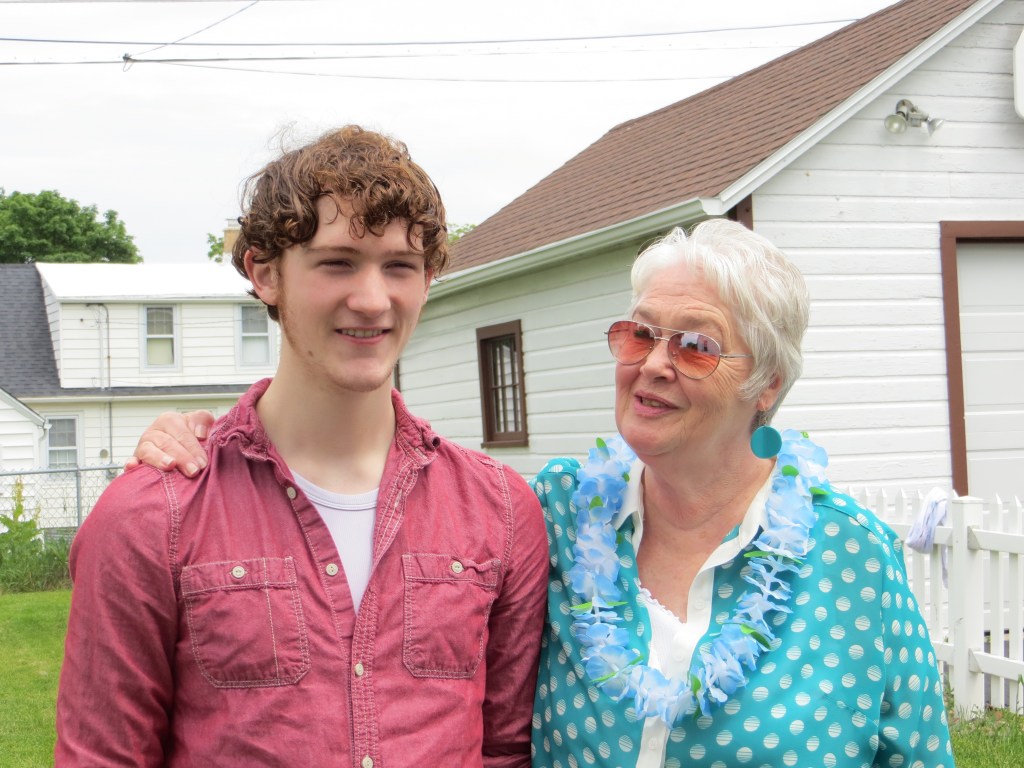
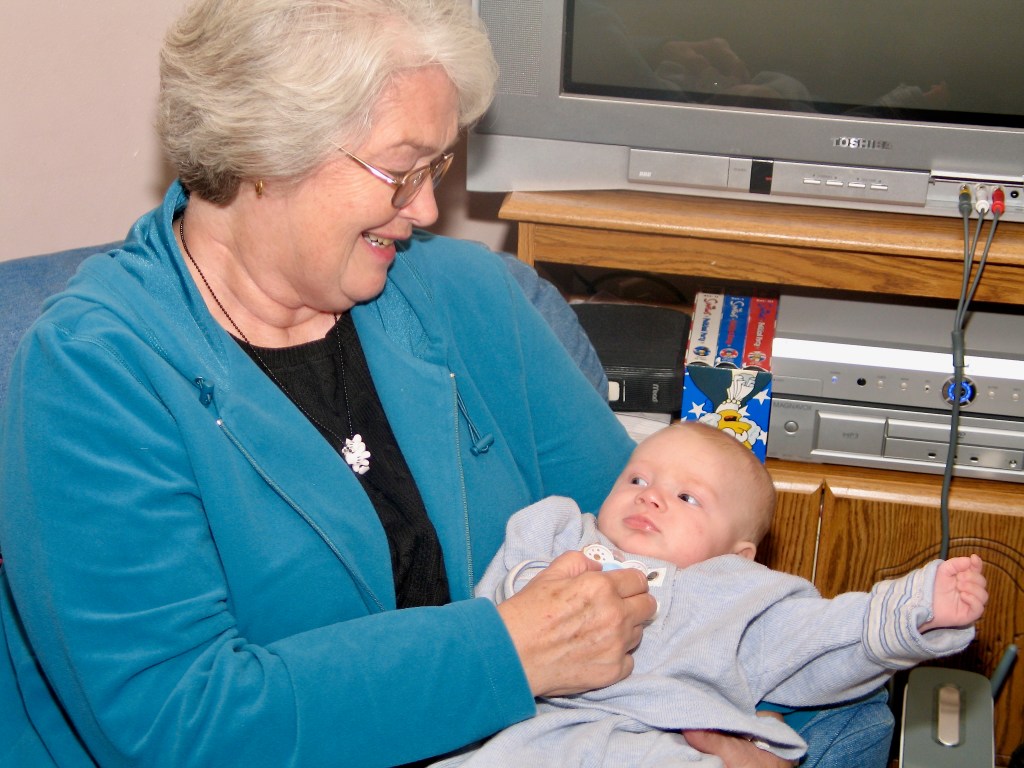
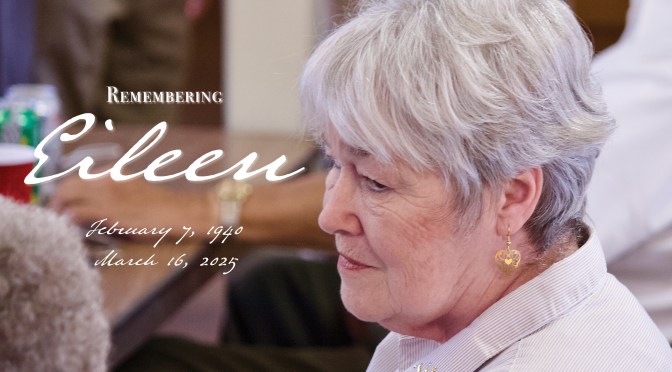
Godspeed to a wonderful mother-in-law, friend and beloved ‘Granny’ to 7

I knelt down to pray the Rosary before the 4 p.m. Mass at St. Albert the Great Catholic Church, about 2 miles from my home. My primary Rosary intention on this windy March Saturday was for my mother-in-law Eileen, who was dying of cancer and congestive heart failure some 80 miles away.

As I finished my Rosary, I heard people begin to file in for Mass. Out of the corner of my left eye, I spotted a woman with white hair and eyeglasses, also kneeling in prayer. I’m not sure what prompted me to look her way again, but when I did, I paused my prayers. I looked back a second time and held my gaze.

At that moment, I wondered if Eileen had died, because the woman I saw praying some 50 feet from me looked exactly like her. I thought (almost aloud), “What am I seeing?” I rubbed both eyes and looked again.

I had to move to a different pew because Mass was starting. I didn’t see her again. I didn’t get a chance to look for the white-haired woman during or after Mass. I took her presence at that moment to be a sign that Eileen had either departed for Heaven or would do so shortly. She was at prayer in God’s house.

“His raiment became white and glittering.”

The Gospel reading for the second Sunday of Lent was from Chapter 9 of Luke. It describes how Jesus took Peter, James and John up the mountain, where he was transfigured before them. His “raiment became white and glittering,” the Gospel says. A cloud enveloped them and they heard the voice of God.

It was a very powerful experience for me. God’s perfect time. Some 15 hours later, at 7 p.m. on Sunday, March 16, Eileen Marie LaCanne left for Heaven. She was 85.

I was most blessed to have a chance to spend a few hours with Eileen during her last week. I had not seen her for years. After getting an update on Eileen’s condition from my daughter Samantha, I felt an urgent—almost panicked—need to visit. I wanted to see her again, and to make sure she received the sacraments of the Catholic Church.

The next morning, I brought my good friend, Father Richard Heilman, with me to visit Eileen. He asked her to hold a beautiful St. Benedict Crucifix while he gave her Last Rites, Holy Communion (in this setting called “Viaticum,” or food for the journey to eternal life). He then gave her an Apostolic Pardon.

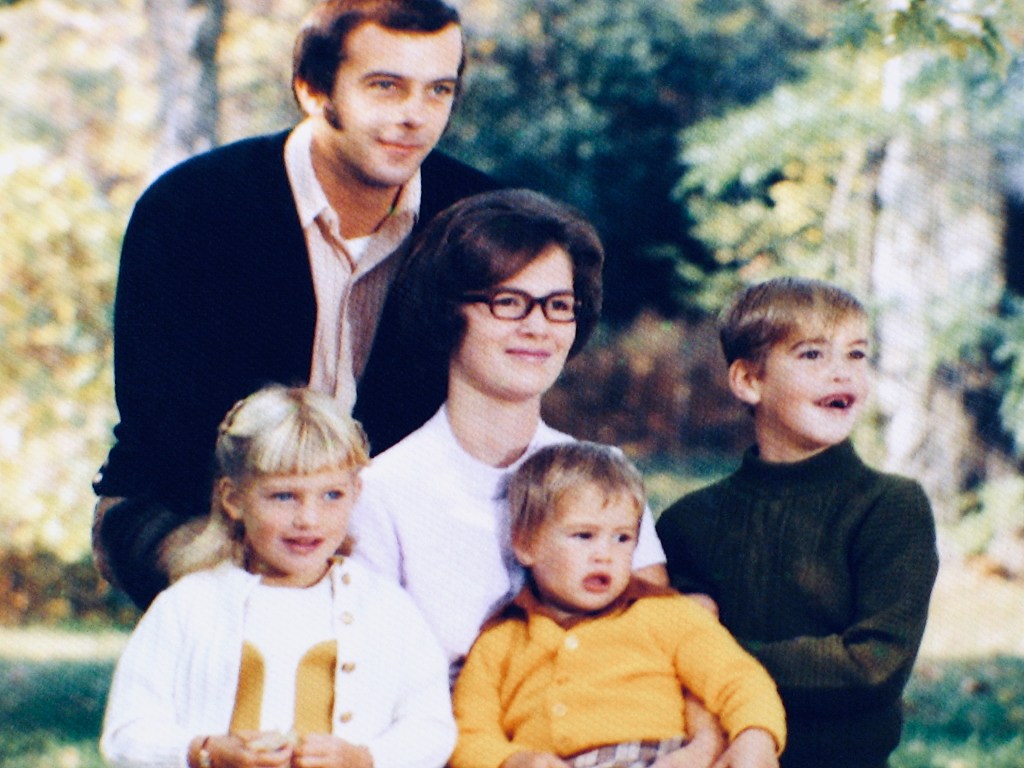
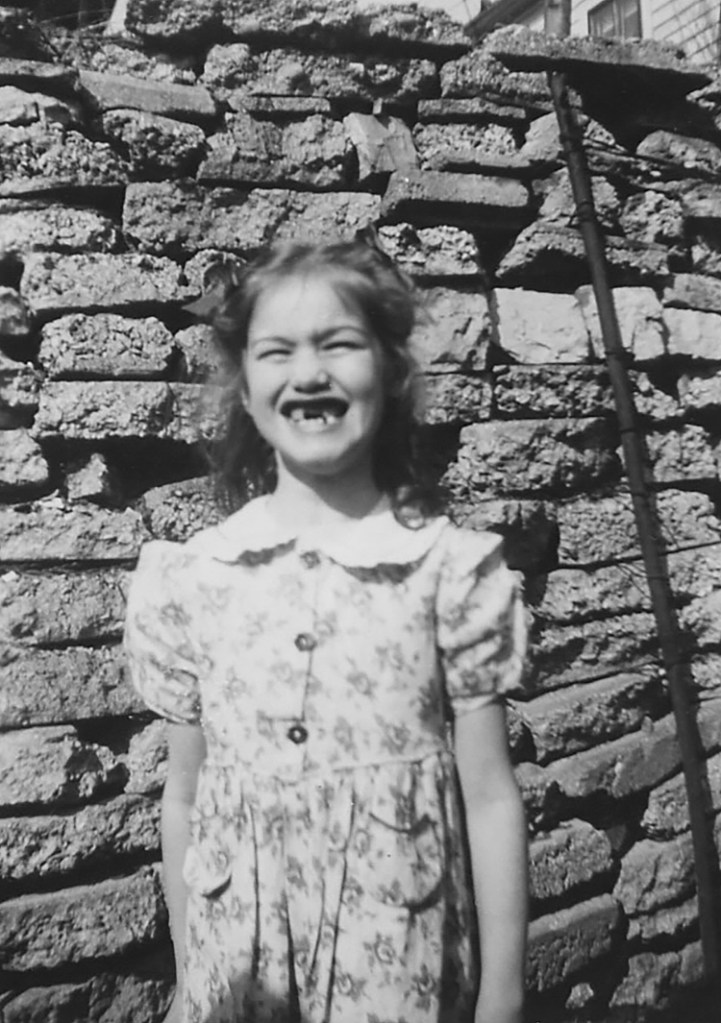
The former Eileen Eichler at home in Racine during her high school years.

Eileen looked tenderly at Jesus on the Crucifix while Father gave her anointing and prayed over her. She trembled slightly as she held the Crucifix. When Father finished, he blessed her with Holy Water from the springs of Lourdes, France, where the Blessed Virgin Mary appeared in 1858. He gave her a Green Scapular that had been touched to the relics of 165 saints and a relic of the True Cross of Christ.

In that moment—in her own way—Eileen was transfigured. Though days of physical pain and suffering still lay ahead, she was now spiritually ready to meet Jesus, assured of the Catholic Church’s full support and prayers in her final days.

Author, author!

Eileen had the soul of an author and poet. She consumed books voraciously, reading thousands of titles across the decades. Looking at all of her books that filled the shelves in her home, I had a thought that tied my mother and my mother-in-law together. My Mom taught reading for nearly three decades. Eileen taught by example the joy of reading. How strange that this thought never occurred to me before today.

Eileen always said she wanted to write a book. Her life and family stories would make compelling reading. She had the material. Despite her self-doubts, she also had the ability.

Eileen did not write a book during her very busy life. She WAS the book. She IS the book. Her volumes of journals are filled with hundreds of powerful entries on life’s joys and heartaches. Those handwritten notes will one day make a beautiful volume—and her name will adorn a hardcover book, just as she always dreamed.

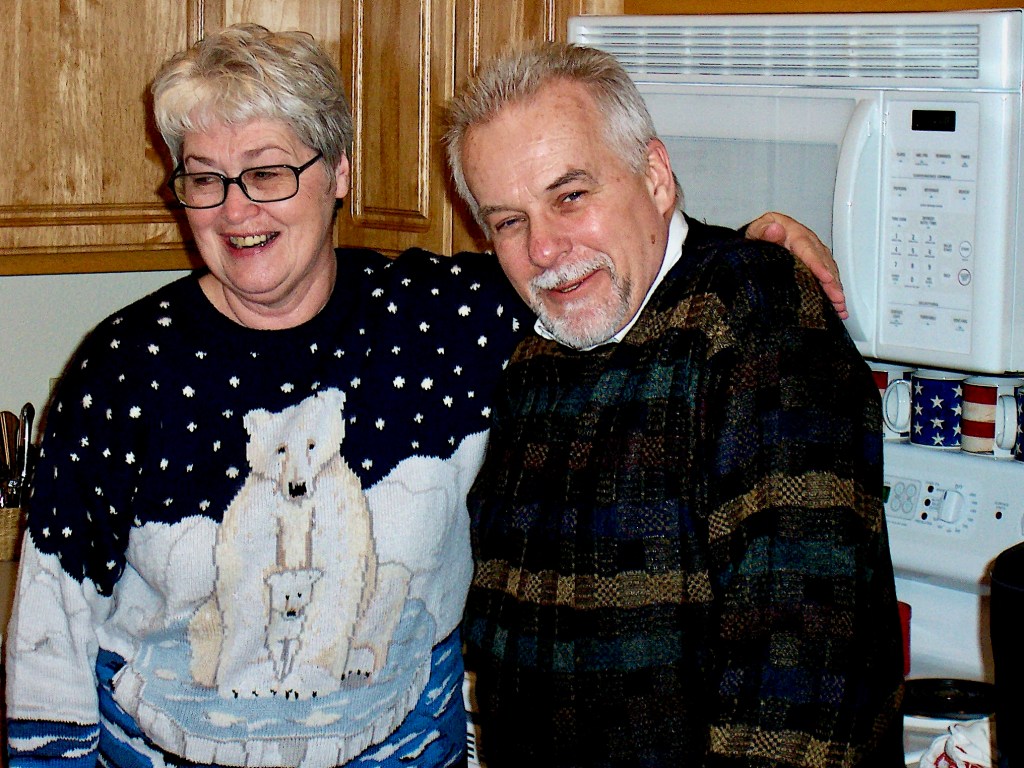
Ron and Eileen were born at the same hospital seven months apart in 1940.

An author of Eileen’s life story would come to know important things. Despite much suffering and sacrifice, Eileen so often rose above it all with a razor-like wit and a sense of humor that would compel Groucho Marx to tip his hat in admiration. I will remember so many things about this dear woman, but nothing more than her infectious laugh. She admitted it sometimes came out at inappropriate times, like when she was nervous. That was one of her charms.

January 21, 1992, was a case in point. Eileen came to visit her first grandchild at St. Luke’s Hospital in Racine. Sue and I both struggled a bit to change Stevie’s diaper. From across the room came that laugh. She could not hold it in. Eileen seemed to enjoy the scene of us floundering. My ears were steaming. Eileen came over and offered to get the diaper on properly. As soon as she unfastened the front, a stream of pee hit her right in the glasses. I felt an urge to let out at least a mild guffaw, but I stifled it like Edith Bunker.

Stevie had some other incidents at Ron and Eileen’s as a toddler. When it was hot out, he liked to walk around “diaper naked,” as he called it. He even had a little song that accompanied his state of undress: “Diaper-naked, eatin’ candy!”

One day Eileen found him peeing through the screen door leading to the back porch. We have photos of him at Granny’s house, butt naked, spraying Eileen’s car in the driveway. He was also known to chase people with the garden hose while in the buff. What a scene.

Laughter and tears were the bookends of Eileen’s life. One challenged and the other soothed. One tested and the other triumphed. Even on her deathbed, watching home movies, that laughter could not be stifled or suppressed. Almost like laughter from Heaven.

The former Eileen Marie Eichler was born on a Wednesday—February 7, 1940—in Racine, Wisconsin. She was the oldest child of Alex Eichler and the former Gertrude Proeber. She and her five siblings were spread in age across 23 years: Allen, Mike, Don, Liz, and Kevin. At age 5, Eileen sang “Our King” in the Christmas pageant at Christ Congregational church, according to an article in the Racine Journal-Times.

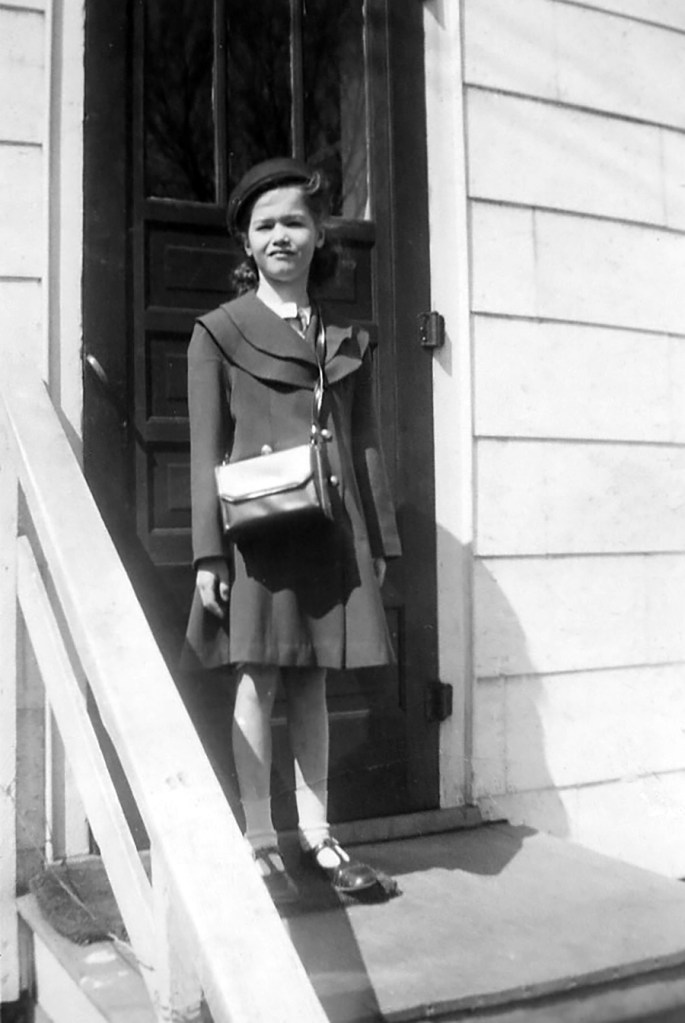
Eileen Eichler (at left) used the power of rhyme to win class office during her junior year.

Eileen’s humor caught the attention of the local newspaper during her junior year at William Horlick High School. She was part of a feature photo atop Page 1 on Dec. 17, 1955. The caption said Eileen “used a play on words to be elected secretary-treasurer.” Her campaign poster featured a character wearing a little cap. The headline read: “Use your beanie. Vote for ‘Enie.”

Her grandchildren would laugh many times when Eileen told them her high school classmates called her “Wiener.” It appears she crafted a version of the nickname herself: “Enie.” Maybe it was “Ener?” I digress.

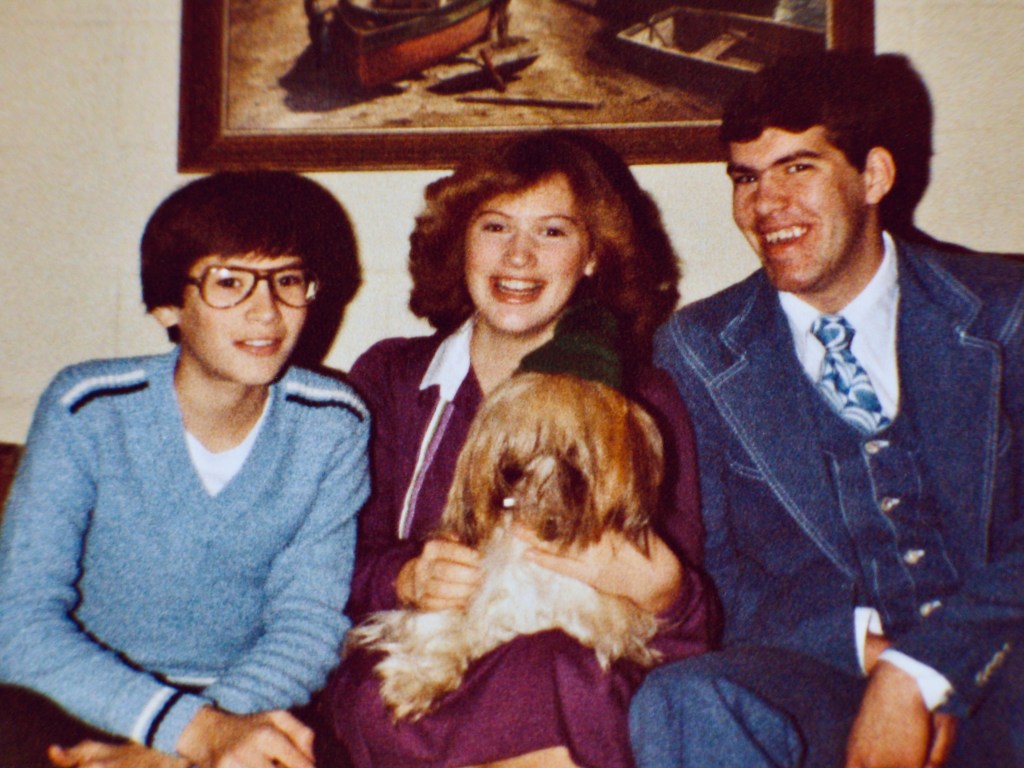
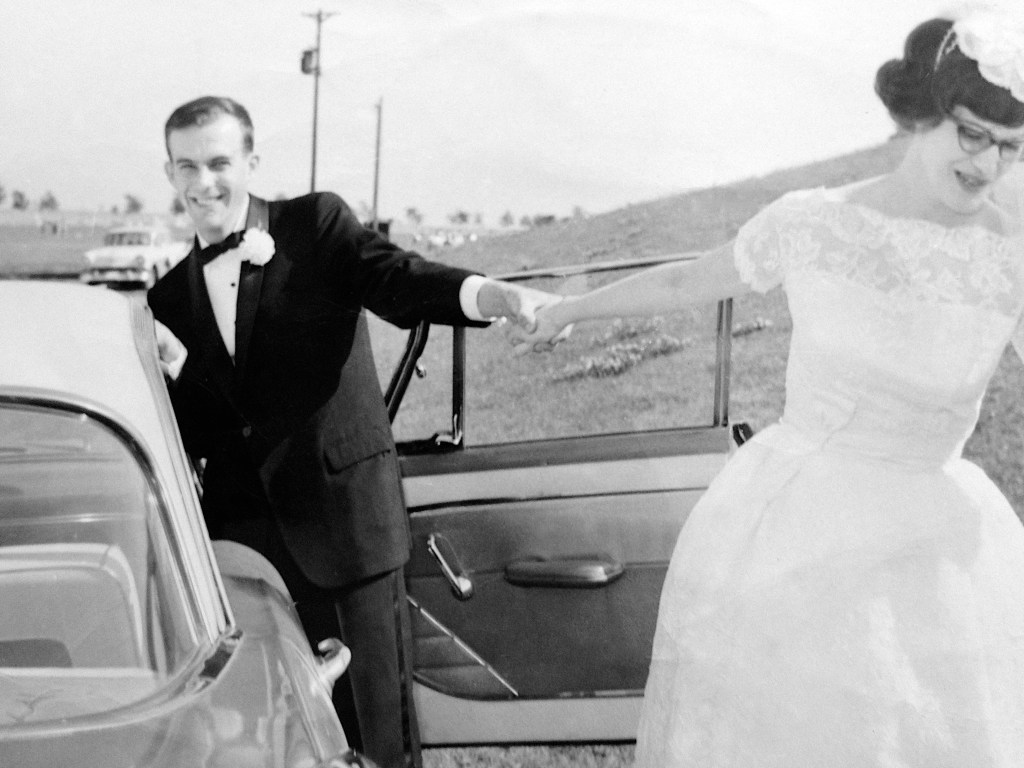
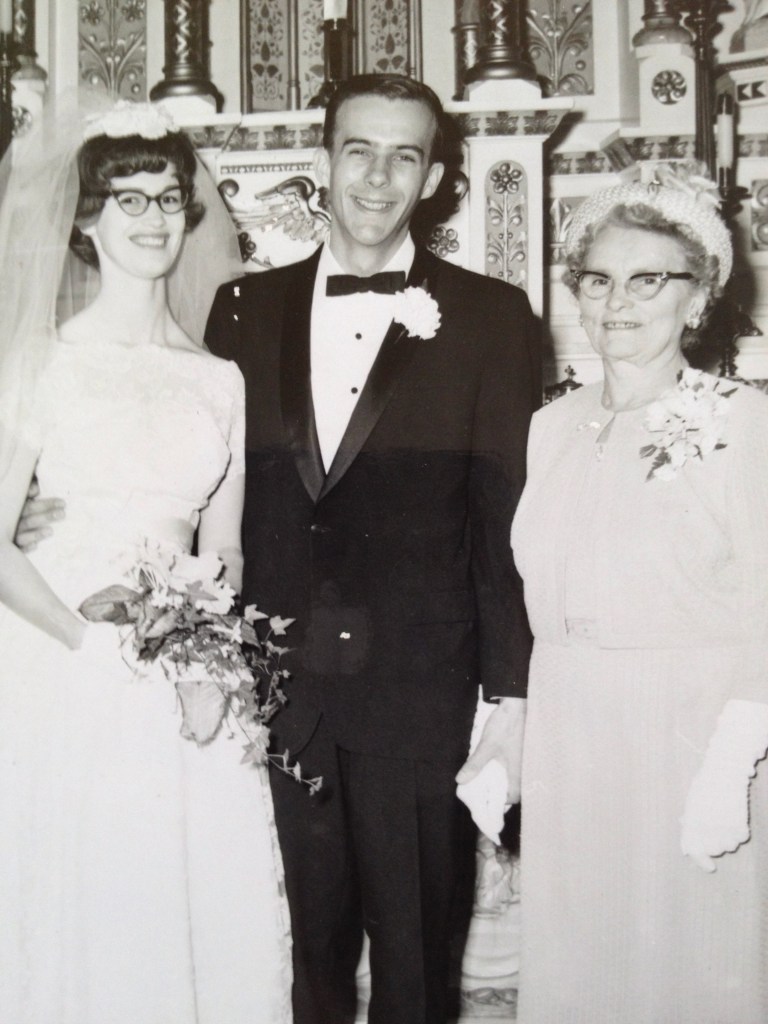
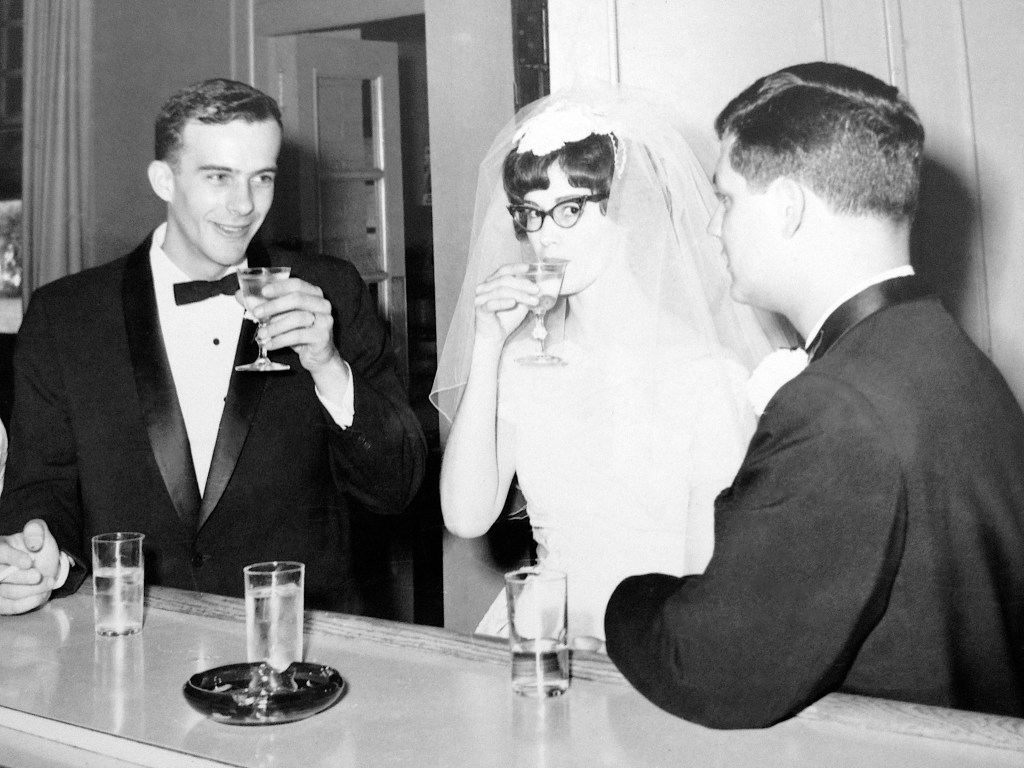
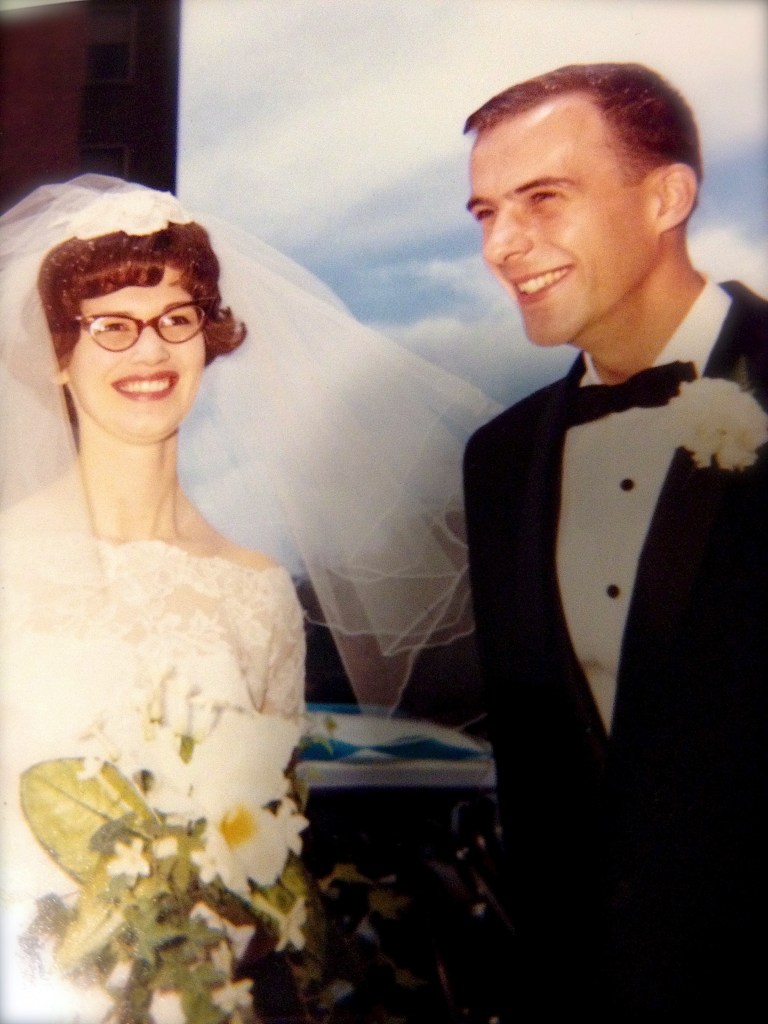
On June 15, 1963, Eileen was united to Ronald Clarence LaCanne in a marriage that lasted more than 51 years until his death on Sept. 25, 2014. They were blessed with three children: Patrick Ronald, Susan Elizabeth and Christopher Charles. Mothering came naturally to her, a vocation that would literally prove lifesaving during more than 38 years caring for a special-needs child while raising a girl and another boy.

Jesus said that there is no greater love than to lay down one’s life for another. That describes the adult life of Eileen LaCanne, caring for Pat, Sue and Chris. No greater love.

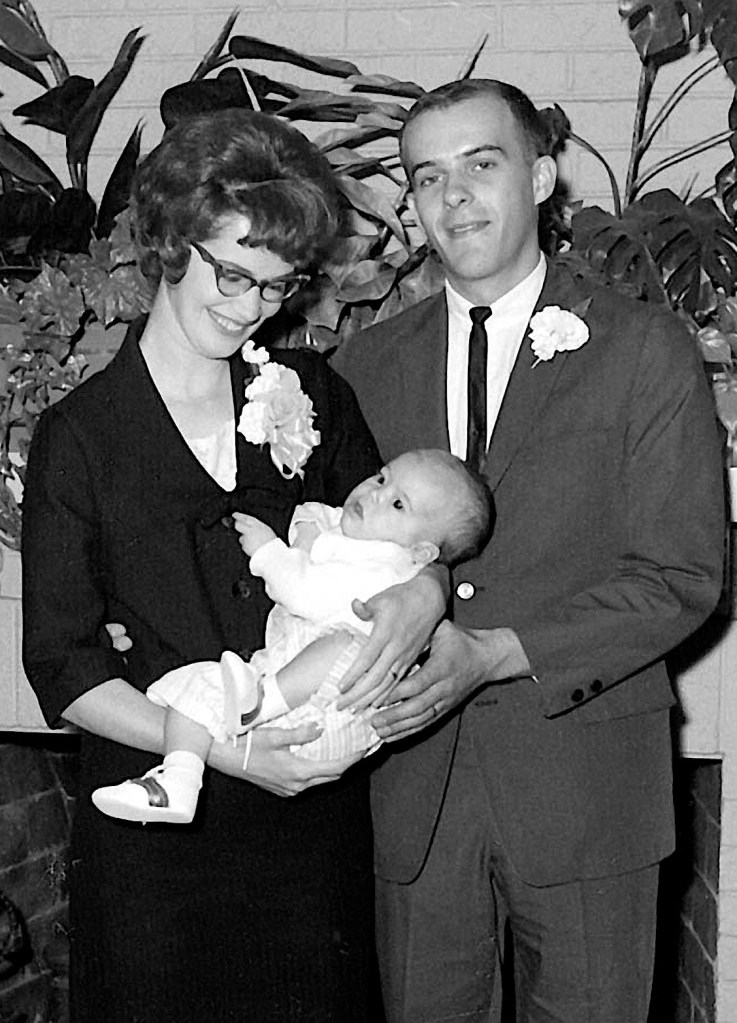
Eileen Eichler and Ronald LaCanne were married at Holy Name Catholic Church, Racine.

But in a most apparent way with Patrick, who was born with a heart defect, survived oxygen deprivation with the umbilical cord wrapped around his neck, and suffered brain damage during a surgery when he was about 2 months old. He developed seizures that were severe and for the most part, beyond medical help.

Miracle treatment

Ron and Eileen took Pat to the Mayo Clinic. In January 1977, he underwent a revolutionary surgery—a hemispherectomy—that removed one lobe of his brain to put an end to the wayward signals that sparked the frequent seizures. Ron called it a “true miracle.” The procedure worked and the seizures stopped.

“He hasn’t had a seizure since,” Eileen told Robert Frahm of the Journal Times in January 1981. “To see him now you wouldn’t believe he came out with no after-effects. I expected him to be somehow an invalid, and he wasn’t at all.”

In 1977, Pat and his classmates in Room 9 at Wadewitz Elementary School helped create a book on dealing with seizures. The project was the brainchild of 23-year-old teacher Jan Damaschke. The book—titled “Gripping Tales”—was dedicated to Pat and classmate Keith Bretl (who died in 1992). Eileen wrote her own reflection for the book on mothering a child who suffers from seizures.

Before his life-saving surgery, Patrick had to wear a helmet when he went out to recess. He referred to himself as “Hard Head Harry.”

“It’s hard to write about my feelings as a mother of a boy plagued with seizures, because I’m afraid I may sound bitter and angry,” Eileen wrote in the 1977 “Gripping Tales” book. “I think I was for a long time. …I felt angry at everyone who had a calm life and had no idea of what we were living with and how this was affecting our whole family.”

One of the true low points, Eileen wrote, was at Halloween 1976, when she had to forego taking Chris trick-or-treating because Pat was on the couch suffering seizure after seizure. If he fell and hit his head, she explained, it could trigger a more severe wave of seizures. “It could be anywhere from 20 to 40 seizures at a time,” she wrote.

A seizure book produced by students at Wadewitz Elementary School was dedicated to Patrick and his classmate Keith Bretl. (Images courtesy of Jan Damaschke)

That following Christmas Eve, seizures left Pat “very hyperactive and unpleasant,” Eileen wrote. During one of these moods, Pat struck his father in the face and broke his glasses during the family’s annual Christmas party.

“Aside from the embarrassment this caused in a room full of relatives (most only seen once a year), the feeling of helplessness and frustration on that night about what we were going to do with Pat was almost too much to bear,” she wrote.

Words truly fail when trying to understand and describe what Eileen meant to Patrick and vice versa. It is often said that there is no love like a mother’s love. Yes, this is true. Eileen was absolute proof of that. It was emotional, exhausting and at times heartbreaking duty, but Eileen willed herself to push onward, even when things seemed darkest.

She and Pat made regular outings to area bookstores. Greenfield News & Hobby was a popular stop, not just for its figurines and memorabilia, but for early runs of pop-culture magazines they both liked to read. Our children often went along on weekend retail outings that forged a special bond with Patrick and Eileen. Pat would have been sad if he lived to see his favorite hobby shop close its doors in 2015 after 50 years.

Gallivanting with Pat also included many trips to the movie theater, often within a day or two of a new Hollywood release. The Lion King, Aladdin, Toy Story, Titanic, A Goofy Movie, Beauty and the Beast, Forrest Gump, The Iron Giant, Austin Powers, Mrs. Doubtfire and Jumanji were just some of films on Pat’s scorecard.
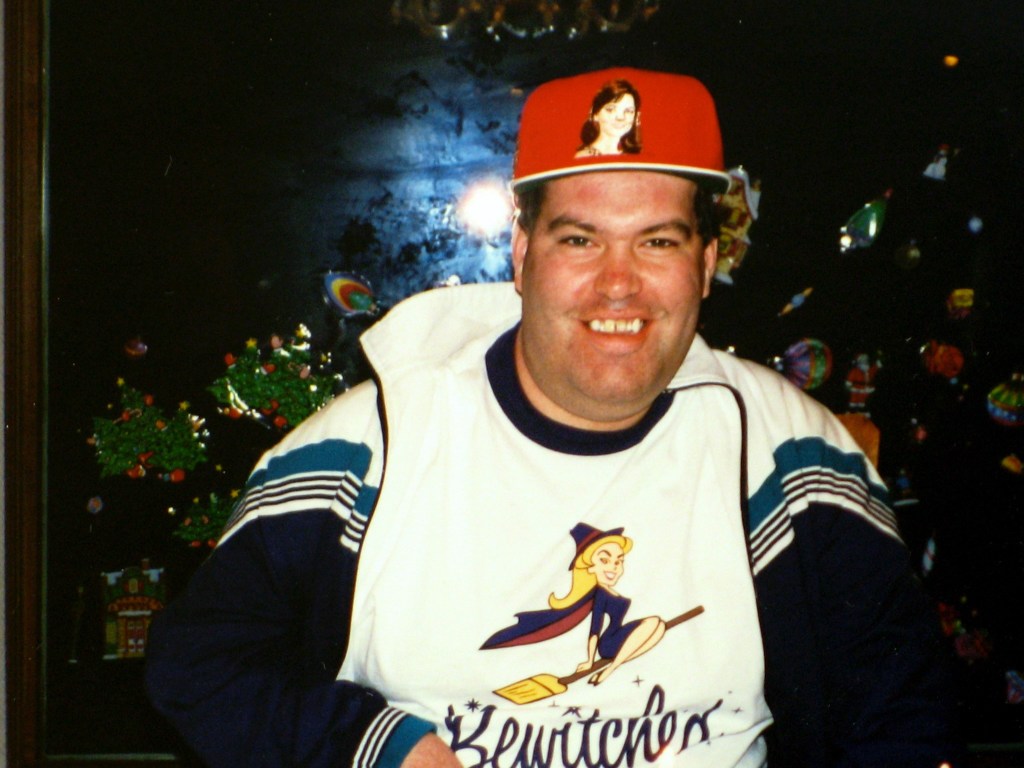
Patrick wearing one of his favorite shirts on an outing with “Ma,” as he lovingly called her.

Stevie accompanied Pat and Eileen to the showing of Jumanji, a pretty intense special-effects fantasy film released in 1995. I was bothered a bit that a 3-year-old sat through that film. Granny was not known for saying no. Jumanji was only rated PG for “menacing fantasy action and some mild language.”

On her deathbed last week, Eileen brought up the film again. She told everyone in the room that I was mad at her for letting Stevie see Jumanji. I was dumbfounded that she had held onto such a belief all this time. I told her I certainly wasn’t angry at her. Any reaction I had happened 30 years ago.

It was a running joke in our family that Stevie got carte blanche when he was little. I would not change a thing, Eileen.

It was not all about retail therapy when it came to outings with Pat. There were countless trips to North Beach on Lake Michigan. As a toddler, Stevie used to demand to go to “Meeshigan.” Then there was the Great Circus Parade in Milwaukee, where Pat met Ernest Borgnine. Other events included parish festivals and even celebrity appearances. Pat met actor Larry Linville (Maj. Frank Burns from M*A*S*H) at Festival Hall.

Patrick’s health travails continued. He had two near-fatal heart episodes in 1997 that led to surgery to replace his implanted defibrillator. He also had surgery on his withered foot, which had gotten weak. He ended up in a wheelchair to prevent a broken leg or ankle. Doctors used bone from his hip to fashion a sturdier foot. After recovery from the surgery, his mobility returned.

Sue and Christopher with brother Patrick at Christmas time in the mid-1970s.

Eventually Patrick again needed a wheelchair to get around. He and Eileen continued the outings as best they could. Eileen told of one day that she struggled to get Pat in the car and the wheelchair in the trunk after shopping at Mayfair Mall in Wauwatosa. It was snowy and slushy. She slipped and fell trying to lift the wheelchair into the trunk. She broke down in sobs. This was just too hard.

And yet she persevered.

Eileen made it her mission to give Patrick a happy life. And that she did. Patrick was a kindhearted, beautiful soul who delighted each of our children, Stevie, Samantha and Ruby, and delighted their cousin, Geoffrey.

Pat was a child at heart. Stevie spent many a night sitting on his bed watching World Wresting Federation (WWF) matches and admiring Pat’s museum-like display of collectibles and cartoon memorabilia.

Patrick’s figurine collection was a legend, paying tribute to the Three Stooges, Betty Boop, Bugs Bunny, Daffy Duck, Aladdin, Homer Simpson, Snow White, Mickey and Minnie Mouse, Fred and Wilma Flintstone, Donald Duck, George Jetson, Mufasa from The Lion King, Lucille Ball, and Mrs. Potts the teapot, voiced by Angela Lansbury in Beauty and the Beast. And many others.

Stevie loved to play with his Uncle Patrick’s vast collection of figurines.

The big wrestling events featured such luminaries as Andre the Giant, Ric Flair, Hulk Hogan, Bret “The Hitman” Hart, “Macho Man” Randy Savage, Ric Flair, Rowdy Roddy Piper, The Undertaker, Yokozuna, Stone Cold Steve Austin, and the great Hall of Fame announcer and former wrestler, Bobby “The Brain” Heenan.

Eileen always made sure Pat got to watch the pay-per-view matches on TV, such as WWF WrestleMania 13, held at the Rosemont Horizon on March 23, 1997. The featured match was between Sycho Sid and The Undertaker. Such luxuries pressed on the tight family budget, but these matches brought Patrick such joy it would be understandably difficult to say no.

I loved and revered Patrick from the first time we met. I invited him to my bachelor party in November 1990. A small group of us went to a Milwaukee Bucks game and then to an old-fashioned two-lane bowling alley housed in a Milwaukee tavern.

Patrick was in his glory, talking pro wrestling with the guys. He blew us all away with his bowling skills. It was no small feat for him to master a game like bowling. His right arm was partially paralyzed and curled up a bit from his disabilities. His left arm made up for it when it came to bowling.

That night, Pat took the bowling ball with his left hand and repeatedly fired it down the alley like a missile. He bowled close to a 200 game. I can still see everyone in my group giving Pat high-fives after each frame. He was truly one of the guys. I treasure my memories of that night.

In 2002, Pat’s health failed. Years before, he had a defibrillator implanted in his chest to correct dangerous heart rhythms, including tachycardia. This incredible device shocked his heart back into rhythm more than a few times over the years. The first one wore out and had to be replaced. A hole in his heart since birth led to a general weakening that grew worse in the fall.

In October, Pat was admitted to Children’s Hospital of Wisconsin, where much of his lifelong cardiac care took place. One night during a visit, I could see Pat was declining. I felt an urgency to get our parish priest, Father Joseph Stobba, to anoint Patrick and bless him for his journey back home to God. I asked Sue what she thought. She cleared it with their parents.
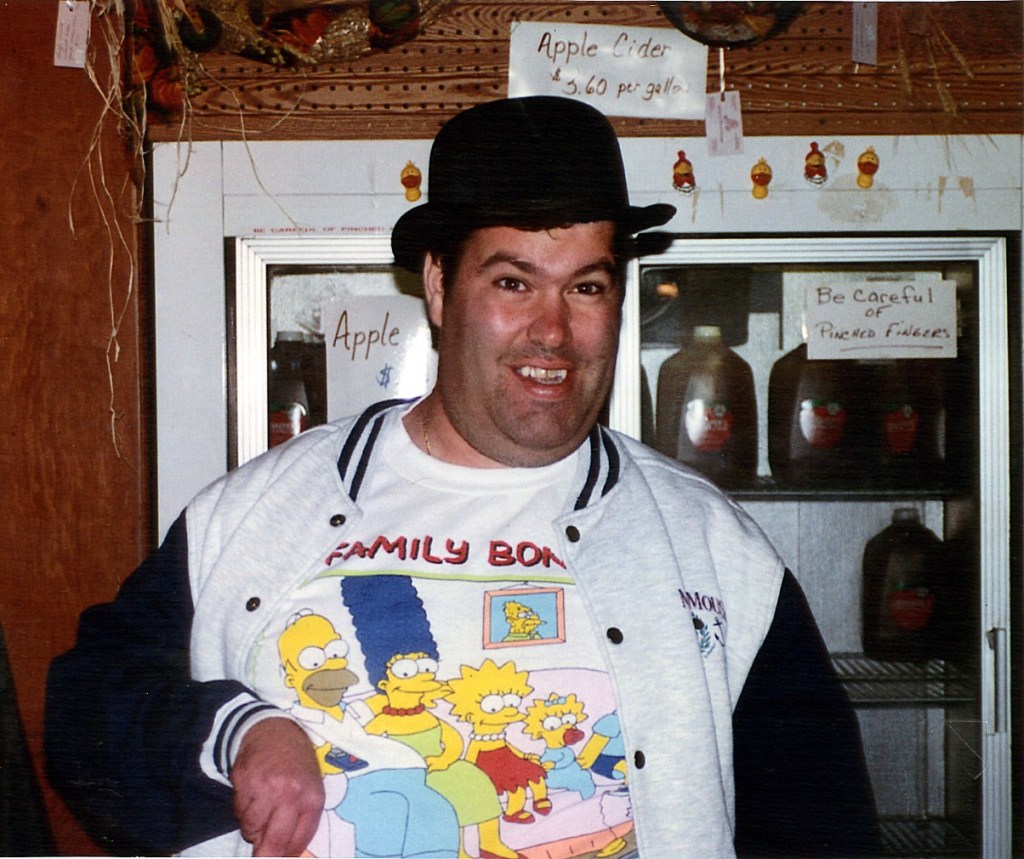
Patrick LaCanne in the gift shop at Swan’s Pumpkin Farm in Franksville, Wisconsin.

Father Joseph drove up in a rainstorm and arrived not even an hour after I called him. Father Joseph anointed Patrick and said prayers for the dying. We all prayed the Our Father. What peace God’s presence brought to that hospital room. Everyone was strengthened by Father’s visit and the Blessed Lord’s comfort.

Patrick died the next day, October 5. He was 38. Forever young. Since childhood, Patrick was obsessed with the number 5 and the color purple. So his death date on the 5th was a bit of Divine Providence.
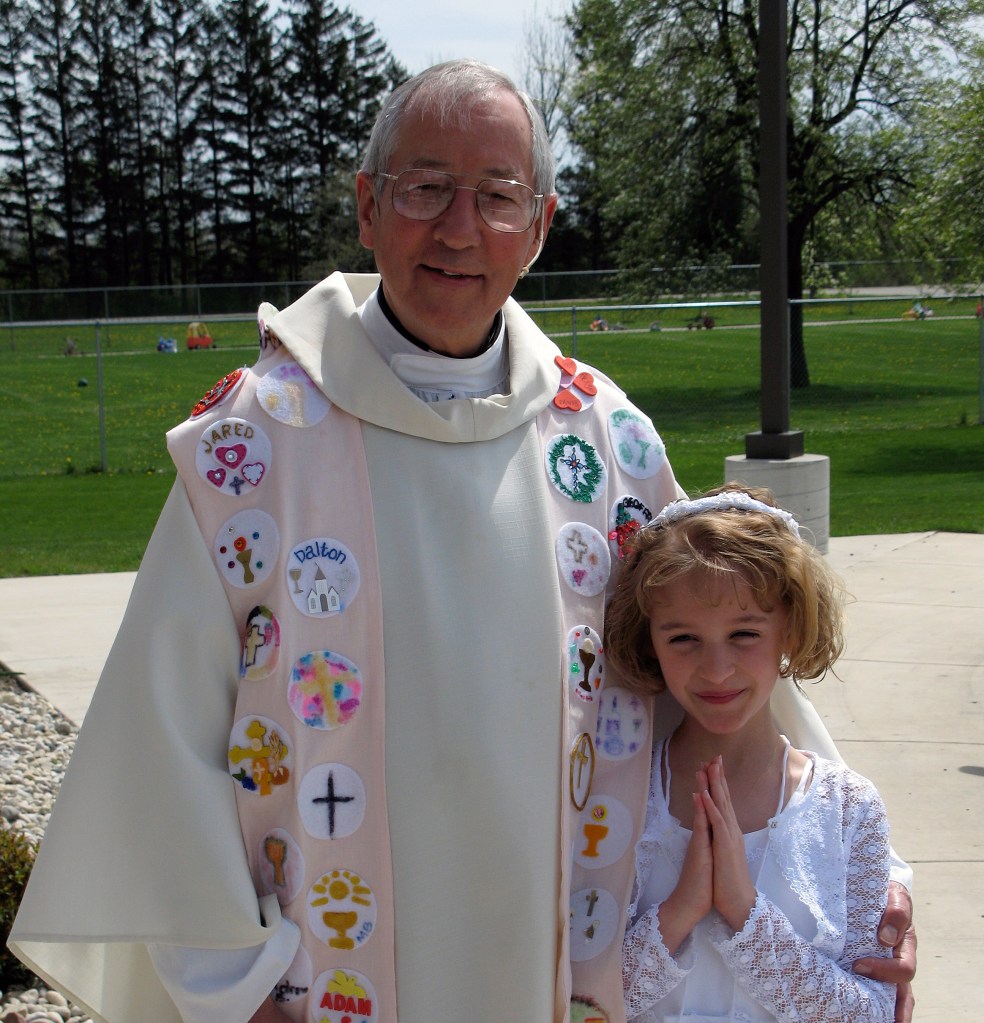
Father Joseph Stobba with our daughter Ruby after her First Communion at St. Rita Catholic Church. Father helped bring Ron and Eileen LaCanne back to the Church.

The loss of a family member can be so devastating that it changes the fabric of life. Nothing feels the same. The world is missing a precious soul. Ron and Eileen felt the loss of their firstborn son more deeply than I could imagine. The bottom dropped out. A deep financial loss due to the collapse of the dot.com economy added to the weight of the crosses Ron and Eileen carried. Depression set in.

At the funeral home, Ron was understandably numb. The funeral director, who had badly botched the long obituary I wrote for the Journal Times, gave an encore in incompetence by getting Patrick’s last name wrong on the prayer cards. “Patrick McCann.” What? Who? Ron told the funeral director it was OK. I don’t know if Ron really comprehended what he saw, but he was not going to make an issue of it.

Sue and I grabbed the funeral guy and explained how not OK it really was. YOU GOT HIS NAME WRONG! YOU MUST REPRINT IT … NOW. Mr. Blunderstumble fixed the mess. He got new cards delivered during the visitation. It was no surprise to us when this funeral home later went out of business.

Ron and Eileen had to sell their house and move into an apartment. A fresh start in Burlington, Wis. The kids loved to visit. The Bridge Street complex sat on the Fox River. The area has a bunch of lakes. Their place was charming and became a new venue for family gatherings. It was a short walk to the Fourth of July parade and fireworks shot over Echo Lake.

My in-laws began coming to Mass with us at St. Rita Catholic Church in Racine. It was a long stretch from their days at the former Holy Name Catholic Church on Grand Avenue in Racine, where they were married June 15, 1963. Eileen had kept her faith alive for many years going to services with her mother Gertrude at Christ Congregational church on North Wisconsin Street. She grew up in that little brick church. Ron had fallen away from the Catholic faith.

“Help! Possible heart attack! I need help!”

Now we all were together at Sunday Mass, followed by what became a tradition: brunch at Douglas Avenue Diner in Caledonia, a mile or so north of St. Rita’s. Family bonds were strengthened during those countless meals. Religion was discussed, along with the news of the day. One of our most memorable weekends came in 2009, when Catholic filmmaker Steve Ray and his wife, Janet, joined us for Mass and brunch afterward. Steve was in town for a talk sponsored by my Knights of Columbus council.

For a time, Ron and Eileen came to live with us in Mount Pleasant after they were forced to leave their Burlington apartment. We had a full house, but it was a blessing. The kids have wonderful memories of having Granny and Gramps all to themselves each day. I would not trade a single minute of it.

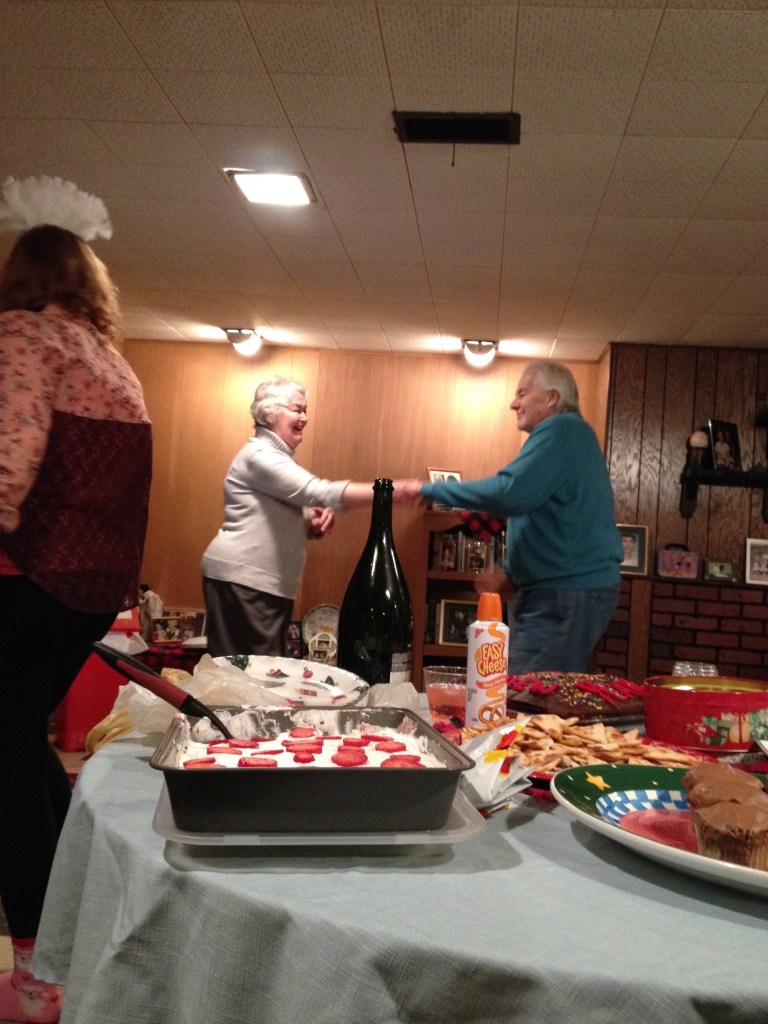
They soon moved into a beautiful ranch home on St. Andrews Boulevard, near St. Mary’s Hospital. The house belonged to Ron’s maternal aunt and uncle, Jackie and Lyle Arnes. More memories were made in this new place. One Thanksgiving meal was served in the finished basement. I will never forget the sight of Ron and Eileen dancing. The kids loved it.

Ron’s health began to fail. One Fourth of July, after we all watched the incredible fireworks in Sturtevant, Wis., Ron stepped into traffic as we walked to our van. We grabbed him, as he clearly could not see the vehicle quickly approaching. That was a close call that jolted everyone’s adrenaline.

He was diagnosed with with prostate cancer. He began having attacks of tachycardia that sent his heart racing. One day while Sue, Eileen and the kids were out on errands, Ron called me. He never called me, so I knew something was wrong. The tachycardia was back.

I raced to the house and helped him get into my Honda Element. I was afraid he was going to pass out. Just as we were pulling out for the short drive to St. Mary’s, I called Sue to meet us at the emergency room. While speeding to get there, Sue was pulled over by a police officer. Eileen went into a panic, got out of the van and began pacing back and forth in the street. “You can’t do this!”

Once they explained the situation to the officer, he let them go. In fact he gave them an escort to the hospital. Moments earlier I reached the ER and ran inside, blurting out, “Help! Possible heart attack! I need help!” As medical staff got Ron out of the car into a wheelchair, Sue pulled up. Eileen raced inside with the medical team. Sue parked my car and headed inside while I took the kids home in our van.

Eileen and Sue watched the doctors use medication and a defibrillator to literally stop his heart and re-start it as a way to restore normal rhythm. It was painful. Ron cried out, “Oh God!” as they stopped his heart and shocked his chest. His heart rate was over 200 beats per minute before emergency treatment returned it to normal. These kinds of crises had become all too familiar to Eileen.

Ron and Eileen moved into senior apartments near the DeKoven Center on the south end of Racine, close to Lake Michigan. Another change of address. It was a nice complex and they made a comfortable home there. Ron’s cancer chipped away at his energy. He lost his eyesight. Eileen took good care of him, as she had for decades.

Samantha, Stevie and Ruby Hanneman with their Grandpa Ron shortly before his death.

I was living in Sun Prairie at the time, but I made trips to visit. One day Ron and I sat in recliners and listened to the Packers game on the radio. We talked about his cancer and death. We talked about our Catholic faith. Ron received visits from the chaplain at St. Mary’s Hospital. They had gotten to know this priest by walking to Mass on Sunday at the hospital. He was from Africa. They forged a special bond. During one visit, Father left Ron with a small “comfort cross” carved from wood. Ron kept it in his palm.

I knew time was growing short during one visit. Ron was so weak he could not get out of bed to take a shower. So I carried him from the bed and got him onto a medical chair in the shower. The warm water soothed the pain and exhaustion in a body that was shutting down. As we got him toweled off, Ron apologized. He never wanted his son-in-law to have to carry him. I told him to put that thought out of his mind. I was honored and blessed to be there for him.

Later that evening we set up a CD player in his room and listened to some faith talks by the late Archbishop Fulton J. Sheen. Sheen taught me the Catholic faith. His eloquence was matched only by his dramatic presentation and ability to make the sacred mysteries understandable for everyone.

A good man gone too soon

Just a few days later I got a call around 3 p.m. that Ron had died. My heart sank. But I had hope, because Ron had embraced his faith late in life. The Africa-born priest became a best friend. Father made sure Ron had the sacraments of the Church. He died in a state of Grace on Sept. 25, 2014. He was 74.

I could only imagine the pain Eileen felt after the service at Draeger-Langendorf Funeral Home, as a military honor ceremony took place just outside the entry. The rifle salute was jarring, with each volley followed by the ting-ting-ting sound of the brass shell casings bouncing on the pavement.

The years after that became a blur to me. I saw Eileen at events like graduations, as well as an occasional Christmas Eve. We emailed and communicated on Facebook. But it was never the same again. I buried myself in a return to journalism during Covid and afterward, investigating the untold stories of Jan. 6 at the U.S. Capitol. I got updates from my children about family events. I treasured receiving photos of them with their Mom and Granny Eileen.
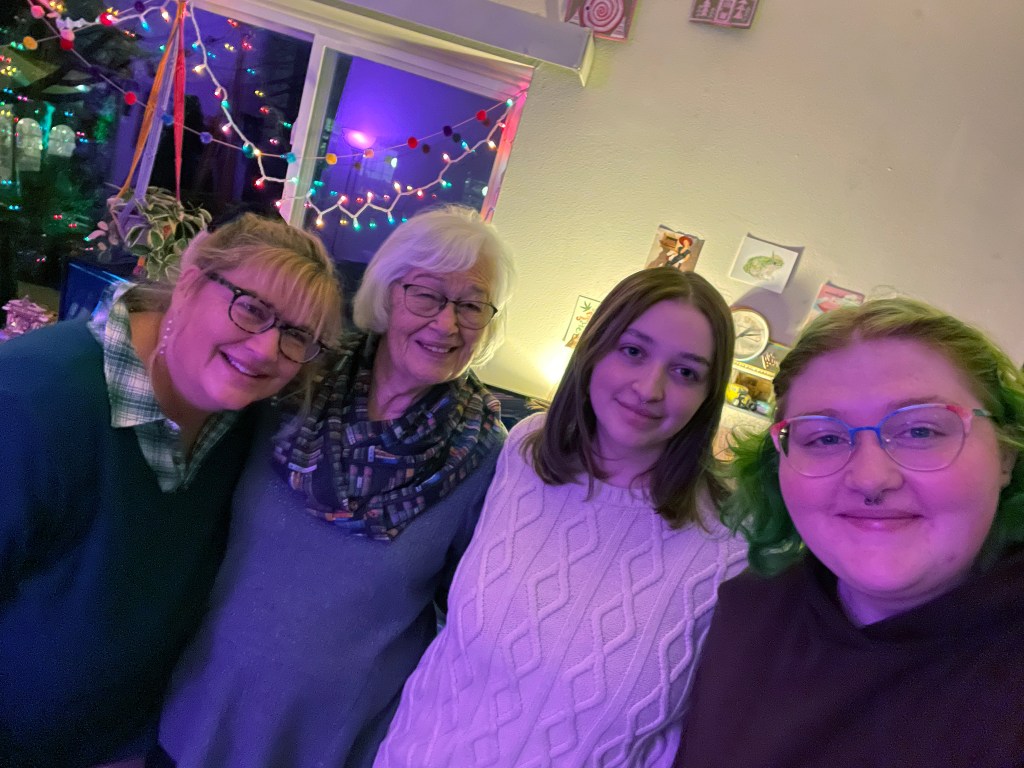
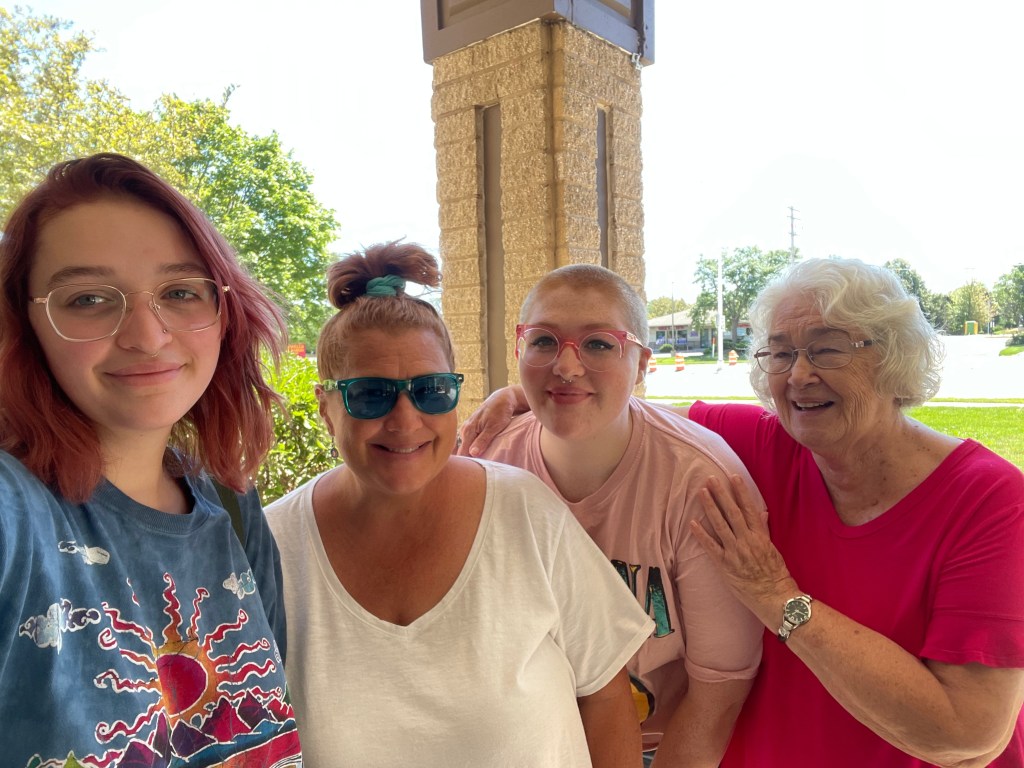
Sue, Eileen, Ruby and Samantha share some Christmas cheer.

The real shock came when I was told of Eileen’s cancer diagnosis in 2024, and again in March 2025 as her life was slipping away. She had decided she would not put herself through the regimens of harsh chemotherapy, or endure all of the awful side effects.

I returned for a second visit on Friday, March 14, 2025. As I left the previous Monday, I told Eileen I would visit again. She grabbed my arm and said in a serious tone, “Don’t just promise you will come. Please make sure you do come back.” So I made her a promise to return and bring home movies for us to watch.

“I want you to know how much you mean to me.”

She had been in and out of consciousness all week. I did not know what to expect when I arrived around 6 p.m. Eileen’s high school boyfriend, Jack Christensen, answered the door. They had rekindled their relationship after Ron died. “I thought you were coming at 5 or I wouldn’t have locked the door,” he said. I apologized for my tardy arrival.

After working through some confusion, Eileen recognized me and recalled my visit with Fr. Heilman. I sat down and flipped open my MacBook Pro laptop computer. Jack propped Eileen up in her hospital bed and she watched some 14 minutes of video memories. I wanted to make a longer video but ran out of time. She watched and even laughed a few times.

A still image from the home movies I showed to Eileen 48 hours before her death.

I sat next to the bed and held her hand. We talked about the “good old days.” She remembered it all. Reminiscing can be such a balm for the soul, even when cancer wracks the body with pain.

Our conversation grew serious. “I want to die. I want to die,” she told me.

“No, you’re not ready yet. You are going to outlive me,” Jack told her.

I said when Jesus calls, she should feel free to go ahead and answer. Wanting to go home to God is normal. She lived a good life, suffered much and walked her final steps with her loving family.

After several hours, I was preparing to depart for my two-hour drive home. Eileen squeezed my hand, looked right at me and said, “I want you to know how much you mean to me.” I was overwhelmed with gratitude. I got a lump in my throat. It took a few seconds to regain my composure.

Those are among the most important and meaningful 11 words I ever heard. That was Eileen’s final gift to me.

When I had gathered my things, I leaned over and kissed her on the forehead, just as I had done to my mother on her deathbed Dec. 26, 2018. “I love you, Granny. You have meant the world to me. The children absolutely adore their Granny. … I’m so glad I got to tell you that.”

Forty-eight hours later, Eileen Marie LaCanne drew her last breath.

Sue and two of our three children were with her. Although she had been in pain and restless, at around 7 p.m. she slipped away. Lifted up by angels to meet Jesus and be reunited with Ron, Patrick, her parents and many others who went home before her.

I had already been working on a slideshow to honor Eileen when my daughters called to tell me she had died. [Watch the tribute video on my JComm website.]

I sat down and began to write this tribute. I did not get far before I was overwhelmed by grief. The sobs came in waves. My little dog Mickey watched me with concern. I regained my composure and reached for the Kleenex box. For a moment, I felt I was watching myself carrying on and wondering, “What is wrong with you? What just happened?”

I came to realize many things reflecting on the 35 years since I first met Eileen. She might have thought I was nuts during my engagement to Sue. One Sunday in 1990 I came over for dinner. Sue was not home from her Army National Guard duty. With war brewing in the Middle East, I was worried her unit would be sent overseas before our December wedding.

The LaCanne family portrait taken in the late 1990s. Ron, Eileen and Pat have since died.

So to burn off my nervous energy, I grabbed the upright vacuum cleaner and zoomed around the expansive carpeted floors of their ranch home. Kitchen, dining room, living room, hallways. Back and forth, back and forth. If I recall, Eileen’s mother commented to her after the vacuum incident that I was “rather peculiar.” Indeed.

I told Eileen many times during those years that she was my second mother. Today I realize that it was even more than that. She was a treasured friend. That’s why we had such fun discussions around the Sunday dinner table. She was easy to talk to and funny—much like someone else in the family that I came to know.

On a Sunday evening in March, I lost my second mother and a dear friend. This kind of person comes along once in life—if one is very fortunate. That’s why Eileen’s death hit me so hard. I’m sure it was much worse for Sue and our children. It’s hard to calculate the depths of this loss.

I left nothing unsaid. I told Eileen I loved her. I thanked her for being a great mother to Pat, Sue and Chris, a very close “Granny” to five grandchildren and a great-grandmother to our two new granddaughters, Gwen and Sabrina.

Eileen’s voice has been stilled.

But just like with Patrick, I can still hear her laughter—all the way from Heaven. •

Watch the tribute video shown at Eileen’s March 29, 2025, visitation.
©2025 The Hanneman Archive

A Wish Granted: Experimental Treatment Cures Sarah Mazzie

By Joseph Hanneman
Racine Journal Times

It was Christmas 1986, and little Sarah Mazzie was making out her wish list for Santa Claus. At the top of the list wasn’t a Barbie doll, a Cabbage Patch Kid or a doll house.

At the top of Sarah’s list was written: “good health.”

“That amazed me, a child that age asking for good health,” said Sarah’s mother, Mary. “It was in that little scrawl handwriting, ‘Good health.’ ”

The 6-year-old Racine girl had her priorities straight. In the 20 months since she was diagnosed with acute lymphocytic leukemia, Sarah learned what it was like to be sick, to endure painful treatments and lose her hair. “Good health” has been on her Christmas list ever since.

This story was part of an award-winning 12-page special section published in The Journal Times  on Dec. 1, 1991. The project won awards from the Wisconsin Newspaper Association, the American Cancer Society and the American College of Radiology.

Bruce Camitta doesn’t look much like Santa Claus. He doesn’t have the Santa-like spare tire, and his thinning crop of hair doesn’t resemble St. Nick’s white mane.

But for Sarah, Camitta might as well have been Santa Claus.

The professor of pediatrics at the Medical College of Wisconsin in Wauwatosa had developed an experimental leukemia treatment that would save Sarah’s life.

Preventing recurrence
Camitta’s treatment used high doses of chemotherapy, followed by an extended period of lower doses, administered after patients had gone into remission. Patients often respond well to initial treatment, but Camitta’s goal was to prevent recurrence of the cancer.

Sarah was his 27th patient in the trial at Children’s Hospital of Wisconsin in suburban Milwaukee, and one of the 80-plus percent for whom the treatment has worked. She has been cancer-free ever since.

“He says I’m a pioneer girl,” said Sarah, now a pretty 11-year-old sixth-grader at Mitchell Middle School. She’s proud that she helped break medical ground and beat the cancer that could have stolen her young life.

“I don’t think about it,” she said of the leukemia. “It’s not hard, I’m just lucky they had medicine.”

Wearing a red shirt, black jeans and deck shoes, Sarah sits in a director’s chair at her family’s home on Newman Road in Mount Pleasant. Her long, black hair, dark eyes and striking smile tell no tale of cancer.

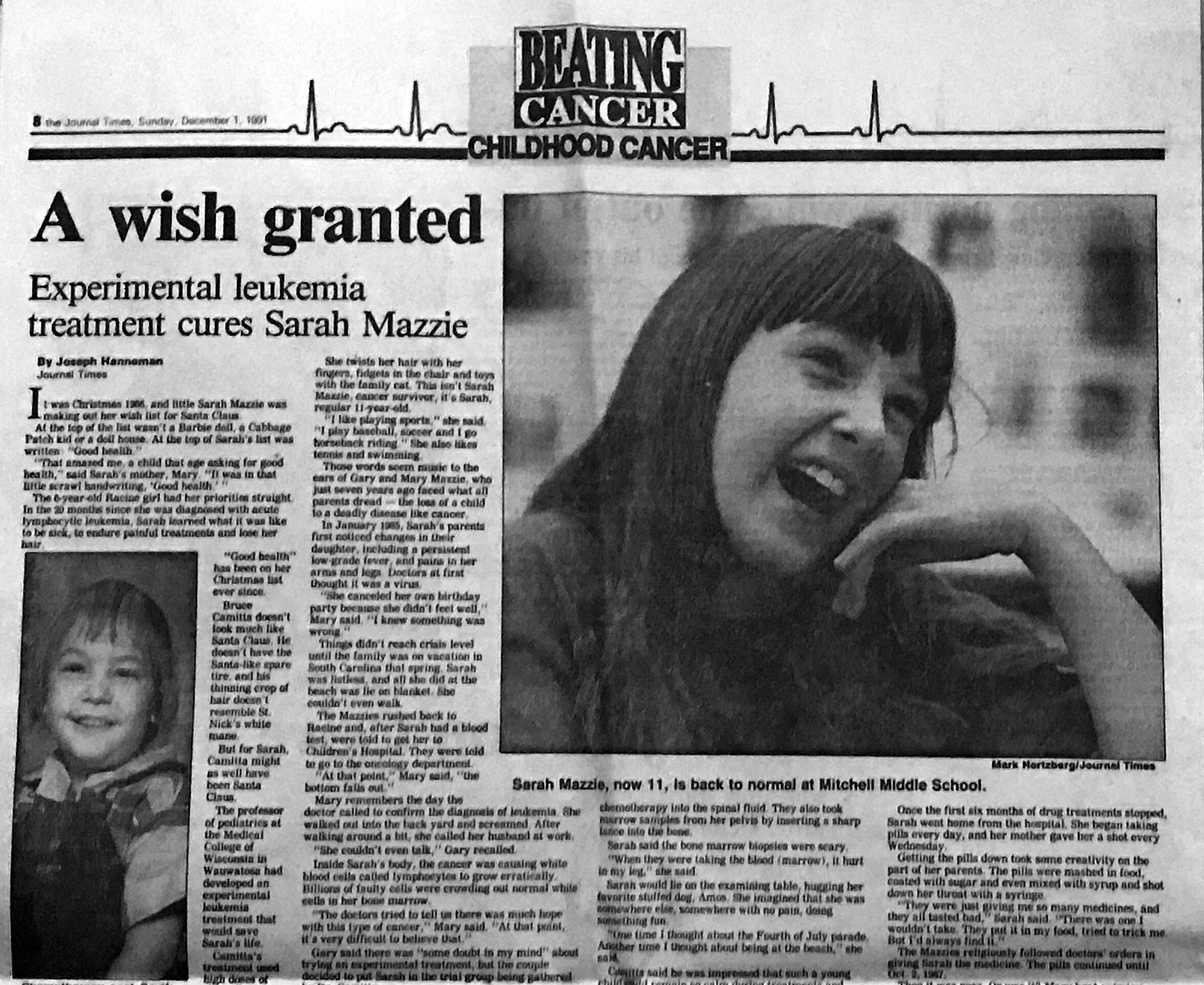
Sarah’s story as it appeared in the newspaper on Dec. 1, 1991.

She twists her hair with her fingers, fidgets in the chair and toys with the family cat. This isn’t Sarah Mazzie cancer survivor, it’s Sarah, regular 11-year-old.

“I like playing sports,” she said. “I play baseball, soccer and I go horseback riding.” She also likes tennis and swimming.

Those words seem music to the ears of Gary and Mary Mazzie, who just seven years ago faced what all parents dread — the loss of a child to a deadly disease like cancer.

In January 1985, Sarah’s parents first noticed changes in their daughter, including a persistent low-grade fever, and pains in her arms and legs. Doctors at first thought it was a virus.

“She canceled her own birthday party because she didn’t feel well,” Mary said. “I knew something was wrong.”

Things didn’t reach crisis level until the family was on vacation in South Carolina that spring. Sarah was listless, and all she did at the beach was lie on blanket. She couldn’t even walk.

‘The bottom falls out’
The Mazzies rushed back to Racine and, after Sarah had a blood test, were told to get her to Children’s Hospital. They were told to go to the oncology department.

“At that point,” Mary said, “the bottom falls out.”

Mary remembers the day the doctor called to confirm the diagnosis of leukemia. She walked out into the back yard and screamed. After walking around a bit, she called her husband at work.

“She couldn’t even talk,” Gary recalled.

Sarah once cancelled her own birthday party because she felt ill. Her parents knew something was wrong.

Inside Sarah’s body, the cancer was causing white blood cells called lymphocytes to grow erratically. Billions of faulty cells were crowding out normal white cells in her bone marrow.

“The doctors tried to tell us there was much hope with this type of cancer,” Mary said. ‘At that point, it’s very difficult to believe that.”

Gary said there was “some doubt in my mind” about trying an experimental treatment, but the couple decided to put Sarah in the trial group being gathered by Dr. Camitta.

Sarah would he treated with standard chemotherapy until the disease was in remission, then undergo six months of intensive chemotherapy and two years of oral anti-leukemia drugs.

Intensive treatment
Camitta said the goal is to keep drug levels high over long periods to reduce the number of leukemic cells in the system. Treating a child who is in remission with intensive chemotherapy was considered a somewhat “rogue” idea in the medical community at the time, he said.

Mary stayed in the hospital with Sarah each night, and Gary visited after work. Sarah was hospitalized for 21 days, and after about two weeks of chemotherapy, her cancer was in remission.

Sarah then came back to the hospital every two weeks for an infusion of methotrexate and 6-mercaptopurine, the drug combination Camitta had chosen for the experiment. Every other week, she went to the clinic for a checkup.

Doctors periodically had to insert a needle into Sarah’s spine to check for leukemic cells, and to inject chemotherapy into the spinal fluid. They also took marrow samples from her pelvis by inserting a sharp lance into the bone.

Sarah said the bone marrow biopsies were scary.

“When they were taking the blood (marrow), it hurt in my leg,” she said.

Sarah would lie on the examining table, hugging her favorite stuffed dog, Amos. She imagined that she was somewhere else, somewhere with no pain, doing something fun.

“One time I thought about the Fourth of July parade. Another time I thought about being at the beach,” she said.

Making something positive
Camitta said he was impressed that such a young child could remain so calm during treatments and tests. “She was super,” he said.

The treatments during those first six months made Sarah sick. The drugs dropped her count of infection-fighting white blood cells. She got headaches, and mouth sores. And her hair fell out.

To help make something positive out of a bad situation, Sarah took the hair that had fallen out off of her pillow each morning, and strung it out on the bushes outside. She wanted the birds to use it to build their springtime nests.

Although she was “kind of scared” about her hair falling out, Sarah adjusted. Most of her friends knew why she was losing her hair.

“When I was in kindergarten, someone thought I was a boy,” she said. “I knew it was going to grow back. I wore a lot of hats.”

Sarah’s parent said she handled the treatments well. She didn’t cry, or fight with the doctors. Her only response was to become silent and withdrawn on the way to the hospital. Occasionally she shed a few quiet tears.

Drug treatments continue
Once the first six months of drug treatments stopped, Sarah went home from the hospital. She began taking pills every day, and her mother gave her a shot every Wednesday.

Getting the pills down took some creativity on the part of her parents. The pills were mashed in food, coated with sugar and even mixed with syrup and shot down her throat with a syringe.

“They were just giving me so many medicines, and they all tasted bad,” Sarah said. “There was one l wouldn’t take. They put it in my food, tried to trick me. But I’d always find it.”

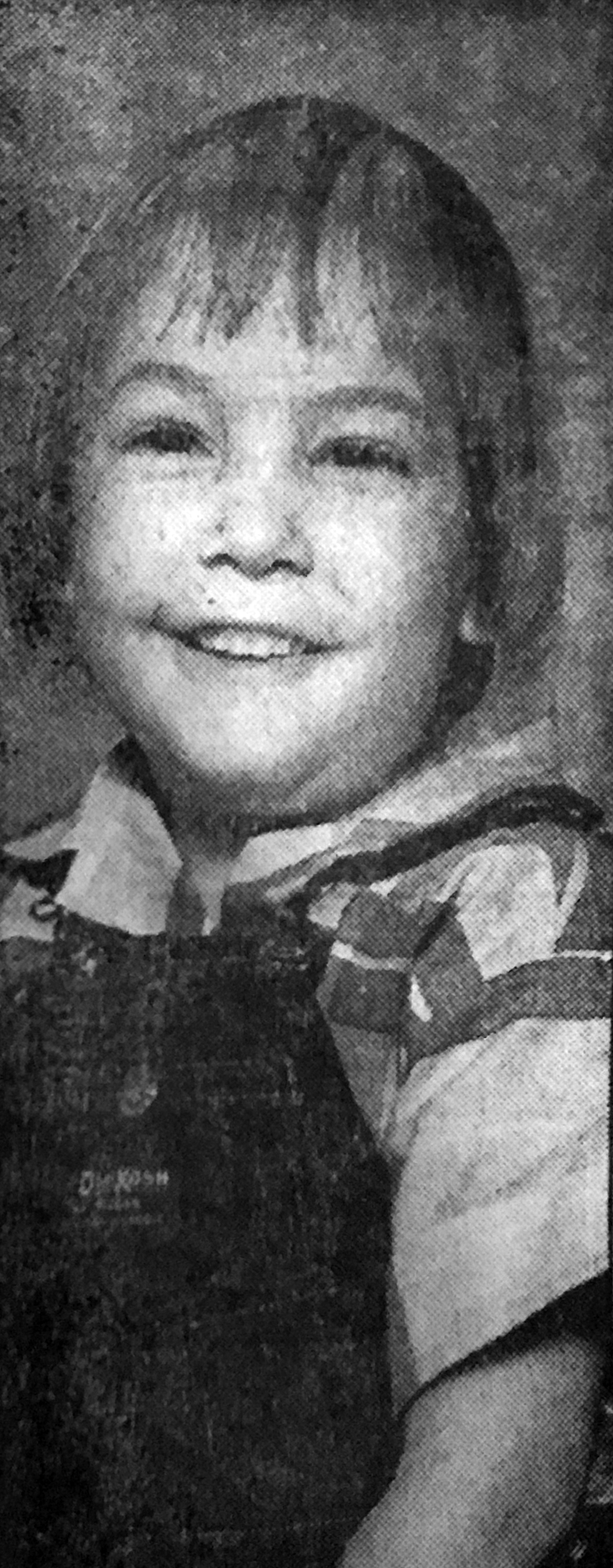
Sarah Mazzie. — Journal Times photo by Mark Hertzberg

The Mazzies religiously followed doctors’ orders in giving Sarah the medicine. The pills continued until Oct. 2, 1987.

Ordeal is over
Then it was over. Or was it? Mary kept quizzing doctors to see if any other children in the trial had a relapse of cancer. They told her not to worry.

Of the 73 children who underwent the treatment in the first two trials, more than 80 percent have remained cancer-free over long periods, Camitta said.

“That’s as good as anything else available, and we’re only using two drugs,” said Camitta, who has a giant teddy bear perched on a file cabinet outside his office. But many more children will have to be tested on the trial nationally to confirm the results, he said.

Camitta won three ardent believers on Newman Road in Mount Pleasant.

Gary said the family is stronger for the ordeal, and he realizes just how fragile life is. Whenever he has a bad day at work, he just looks at a picture of Sarah from back then, and is reminded of what is most important to him.

As for Sarah, she’s gotten on with her life, and will turn 12 in February. Asked if she has any advice for other children with cancer, she doesn’t hesitate in her response.

“I’d tell them you’d probably get better. If they cured me, they should probably be able to cure kids now.”

EPILOGUE: Sarah B. Mazzie graduated from the University of Wisconsin in 2002 and earned her Juris Doctor degree from the DePaul University College of Law in 2006. She was a partner in her own law firm and has worked for Immigration and Customs Enforcement in the U.S. Department of Homeland Security. Now 40, she is a U.S. immigration judge in Minneapolis. Her parents Iive in Racine.

Top photo: Sarah Mazzie in her classroom at Mitchell Middle School in Racine. — Journal Times Photo by Mark Hertzberg.

Judge Gets Final Word, ‘You Are an Armed Robber,’ Then Drops the Hammer

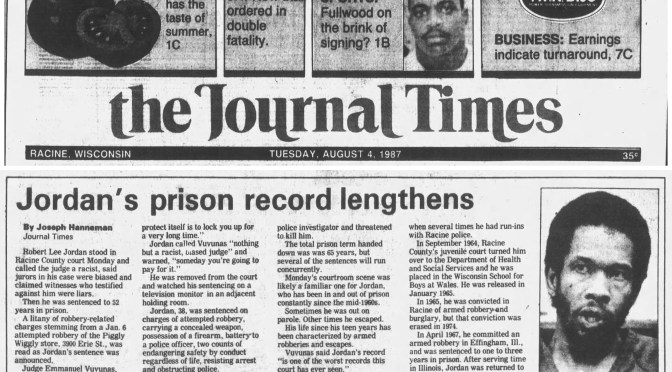
This article appeared on Page 1 of the Aug. 4, 1987 issue of the Racine Journal Times.

By Joseph Hanneman
Racine Journal Times 

Robert Lee Jordan stood in Racine County court Monday and called the judge a racist, said jurors in his case were biased and claimed witnesses who testified against him were liars.

Then he was sentenced to 52 years in prison.

A litany of robbery-related charges stemming from a Jan. 6, 1987 attempted robbery of the Piggly Wiggly store, 3900 Erie St., was read as Jordan’s sentence was announced.

Judge Emmanuel Vuvunas, after listening to a blistering verbal attack from Jordan, said, “The only thing society can do to protect itself is to lock you up for a very long time.”

Judge Emmanuel Vuvunas (Racine Journal Times photo by Jim Slosiarek)

Jordan called Vuvunas “nothing but a racist, biased judge” and warned, “someday you’re going to pay for it.”

He was removed from the court and watched his sentencing on a television monitor in an adjacent holding room.

Jordan, 38, was sentenced on charges of attempted robbery, carrying a concealed weapon, possession of a firearm, battery to a police officer, two counts of endangering safety by conduct regardless of life, resisting arrest and obstructing police.

He was convicted in June for the robbery attempt, in which he struggled with an off-duty Racine police investigator and threatened to kill him.

The total prison term handed down was was 65 years, but several of the sentences will run concurrently.

Monday’s courtroom scene was likely a familiar one for Jordan, who has been in and out of prison constantly since the mid 1960s. Sometimes he was out on parole. Other times he escaped.

His life since his teen years has been characterized by armed robberies and escapes. Vuvunas said Jordan’s record “is one of the worst records this court has ever seen.”

According to court records, Jordan’s problems with the law began between 1961 and 1974, when several times he had run-ins with Racine police.

In September 1964, Racine County’s juvenile court turned him over to the Department of Health and Social Services and he was placed in the Wisconsin School for Boys at Wales. He was released in January 1965.

In 1965, he was convicted in Racine of armed robbery and burglary, but that conviction was erased in 1974. In April 1967, he committed an armed robbery in Effingham, Ill., and was sentenced to one to three years in prison. After serving time in Illinois, Jordan was returned to Wisconsin and paroled in July 1970.

Less than one month later, he committed another armed robbery in Racine. While in Illinois attempting to help recover items taken in the robbery, Jordan escaped from Racine police. He was captured and in February 1971 sentenced to 12 years in the Green Bay Correctional Institution.

In February 1973, Jordan was transferred to the State Farm in Union Grove. Eleven months later, he escaped from the farm. A 2½ year sentence for the escape was stayed and Jordan received probation.

He was again paroled on Nov. 19. On Nov. 20, 1974, Jordan was arrested and charged with committing armed robbery while an escapee from the Union Grove farm. Charges in that incident were considered later in a separate case. Three months later, Jordan committed armed robbery in Janesville and was sentenced to 10 years in prison, with a six-month jail term to run concurrently.

Jordan was sent to Oakhill Correctional Facility in Dane County. On Aug. 31, 1978, he escaped. Eventually he turned up in Avon, Mass., where on Dec. 1, he robbed a bank. He was charged with kidnapping, three counts of assault with intent to commit murder, assault and battery, use of a dangerous weapon, armed robbery and unlawful carrying of a firearm.

He was sentenced to six to 15 years and sent to the Massachusetts Correctional Institution at Walpole. On Dec. 15, 1986, he was paroled and returned to Wisconsin. On February 25, 1986, Jordan was released from prison on his mandatory release date for the 1975 robbery.

On Jan. 6, 1987, he was arrested for the Piggly Wiggly incident.

Jordan represented himself during the trial, which became characterized by his flashes of hostility toward Vuvunas, Assistant District Attorney Eric Guttenberg and the jury.

He said the case was decided by an “all-white, biased jury.” Referring to witnesses who testified against him, Jordan said, “All these people came and lied.”

But Vuvunas got the last word.

“The evidence in this case was absolutely overwhelming,” Vuvunas said. “The evidence was so overwhelming in this case that it really didn’t matter whether you had an attorney.”

Vuvunas, citing Jordan’s extensive criminal record, said it is clear the only choice was to impose a stiff prison term.

“You are an armed robber,” Vuvunas said. “I don’t think you’ve changed your spots. You’re still an armed robber. 

“This court has to make sure that a person as dangerous as you be kept out of the community for a very long time.” •

EPILOGUE: Jordan remains incarcerated at the Stanley Correctional Institution in Chippewa County, Wis. He filed a number of lawsuits from prison, one seeking $2 million from the Racine County district attorney, the Wisconsin attorney general and the head of the Wisconsin Department of Corrections. A federal judge denied his motions for damages and early release from prison. 

Judge Emmanuel Vuvunas is retired.

Army Couldn’t Wait for Couple’s Christmas Wish

This article sat atop Page 1 of the Racine Journal Times on December 25, 1990. It was one of the few times I wrote about my personal life in the pages of the newspaper. The memories are still vivid nearly 30 years later.

By Joseph Hanneman
Racine Journal Times

For many Americans, Christmas Eve was spent gathered around the tree with family members, exchanging gifts and enjoying the holiday spirit. 

But for my family, there really is no Christmas this year. 

Instead of wrapping gifts, toasting with a glass of eggnog or listening to Bing Crosby sing “White Christmas,” my wife of three weeks, Susan, and I spent our first Christmas Eve together saying goodbye. 

Tears streamed down my face as I watched her board a bus Monday at Fort Sheridan, Ill., as her Army Reserve unit shipped out on its way to Europe and Op­eration Desert Shield. 

It seems for the U.S. Army, there is no Christmas ei­ther. 

The Persian Gulf crisis could not wait. 

Fort McCoy, Wis., where my wife’s plane will depart today -— Christmas Day — could not wait. 

Reserve units from Illinois and Wisconsin, which will board planes and leave on the one day of the year that symbolizes peace and brings together families, could not wait. 

It could not be Dec. 26, or 27. It had to be on Christmas. 

It was necessary, they say. I just wish I could believe that. 

If I have just one Christmas wish this year, it is that the people of this country think about what is happen­ing in the Persian Gulf.

As you open your gifts today and hear songs about “Peace on Earth, Good Will to Men,” think about it. This year, those words should carry extra meaning. 

As Christmas dinner is served, don’t forget what this crisis is doing to the citizen-soldiers of the military re­serves, or the sacrifice they are making. Remember their families, who this year spend the holidays filled with worry and uncertainty.

And realize that the impacts of this crisis go well be­yond what most people have heard. 

When George Bush decided to turn up the heat and mobilize more reservists than have been called since the Korean War, he affected more people than most of you will ever know. 

My situation is painful, but I am very lucky. My wife will not be in Saudi Arabia, scorched by heat, bored by the de­sert and worried about war. I thank God for that every day. 

Our story is far from unusual. Since the reserves were first called up in August, our lives have been under a cloud.

The specter of being sent to Saudi Arabia filled every day with worry. Every day that should have been full of excitement as we planned our wedding was shadowed by fear that the ceremony would not take place. 

We heard a million ticks of the clock during those months, but we made it to our wedding day, Dec. 1. We forgot about the Army for a while. We went on our honeymoon.

But we cut it short and came home when her unit was activated.  “That’s all right,” we said, “we will still have Christmas.” 

Between scrambling to put wed­ding gifts away and move into our home, our days have been filled with tension and bureaucracy. Power of attorney had to be de­cided, many forms filled out.

She will take a more than 40 per­cent pay cut from her job by being on Army pay. Forty percent cut, but no relief from creditors. Our in­terest rates are reduced a bit by Uncle Sam, but the bills keep com­ing. 

So we will sell one of our cars. We don’t have to, but we have this crazy idea about having enough money for phone bills, and for plane tickets when I go to visit. 

But again, we are lucky. She will be stationed where there are phones, and where a husband can fly in and see his wife. 

We are lucky, because we don’t yet have children who will see their mother taken away on Christmas Day. She’s not one of the single mothers who was forced to find care for her baby because the Army called her to duty. 

We don’t have a new house to worry about, or mortgage payments to make, like many reservists.

And we have had time together. It took getting up at 4 a.m. each day to make sure she reported promptly by 5:30 for duty, but we had time. Time to talk, and prepare, and pray for the day this whole thing ends and everyone comes home. 

We got so close to Christmas, we felt sure we would be safe for the holiday. Surely, I thought, even the Army believes in Christmas. Now, I know better. 

But we are lucky, I keep telling myself. And in the end, I know I will see the wisdom in those words.

But standing on the wind-whipped pavement of a cold military base on Christmas Eve, I don’t feel very lucky. 

(From the Dec. 25, 1990 issue of The Journal Times, Racine, Wis.)

Dad’s Epiphany on 6-year-old’s first day of school

By Joseph M. Hanneman
Written August 1998 

It was one of those days that heightens the senses, tests emotions and really brings home the meaning, beauty and challenges of life. The first day of school in Racine  was arguably like countless other August days in Wisconsin. Except this time it was my 6-year-old son Stevie head­ing off to a new life. 

Much to my surprise, it was I who felt the impact. And ironically, I was the one who learned the most that warm August day. 

While I had worked all summer to prepare Stevie for what it would be like to start first grade, I wasn’t ready for how it would affect me. I’d never thought much about it, frankly. Why should it be any different than kindergarten, or day care? But by the end of this hallmark day, I came to realize many things, not the least of which was just how much I love and admire my children and my wife.

As I watched Stevie get dressed for his first day of first grade at Racine Montessori School, he seemed to grow up right there before my eyes. His nervous look as he slung his backpack over his shoulders and walked to the car stirred old feelings in me, memories of stiff new outfits, hairspray and early morning front-porch pictures. As we drove the 5 miles to school and chatted about what first grade would be like, I saw myself in the back seat. Only braver. Still shy, but more sure.

Things were changing this day. Big things.

 I walked Stevie to his new classroom and watched him put his lunchbox on the hall shelf. I felt proud of him. But I was nervous because I knew he was about to pass into a new phase of his life. I stood in the comer of the polished hardwood floor as his new teacher showed him his school supplies and sat at the table explaining the new routine. He looked apprehensive — just how I felt. But he was OK. I gave him a quick hug and kissed the top of his head, just like I’ve always done. I wanted to cry. I wanted to take him back home, roll back time and replay our years together. I wanted to once again play blocks, to have him crawl on my back, or run to me when I got home from work, shouting, “Daddy!” 

Instead I stood in the doorway of this magnificent old brick schoolhouse and watched as the teacher’s aide snapped Stevie’s picture. More kids entered the room. A new school year. Time to go, Dad. It’s OK. We’ve got many more milestones ahead.

Until my dying day I will not forget that scene, a picture of my little boy sitting at that little table in a big place. It’s burned into my memo­ry like a favorite page in a scrapbook, only this page is marked with a teardrop. 

As I drove back home, I listened to Elton John sing, “Don’t Go Breakin’ My Heart” on the radio and laughed. Too late. I realized our baby was on his way in life, a journey that would take him through science camps and football games, sleepovers, Boy Scouts and someday, dating. It had never hit me like this before. He’d be home by 4, still my boy. But older. Taller. More handsome.

He’s growing up. Didn’t I see it before? Never like today. 

Stevie on a Racine Montessori School field trip.

This was quickly becoming a day of epiphany for me. I got home and our 2-year-old, Samantha, ran to give me a hug with her enthusiastic shout, “Dada!” I realized more than ever how much I loved being father, a Dad. I treasured the morning, as Sam and I read books and played Dolly House. “Don’t read your paper, Dada,” she said. Okay, honey. Okay. Let’s read your books. Let’s play horsey. Let’s just sit. One day when I walk you to first grade I’ll stand in the doorway and remember today. And I’ll smile because I was here. I experienced it — and I appreciate it.

I’ll remember.

After Samantha and my wife Sue left to run some errands, I had more time to think. Clear and vivid thoughts. Almost revelations. Surely I knew all of these things before, but God chose today for me to really see them.

As I looked out our front bay window at the perfect blue sky and sunshine, I felt in my heart how blessed I am. I thought how much I admired Sue. The night before she and Stevie set up orange cones in the back yard and practiced soccer kicks for his upcoming foray into youth soccer. She’d  just spent three hours in a clinic for new volunteer coaches for Stevie’s new team, the Bears. No hesitation for her. She and the other would-be coaches waddled around the practice field with soc­cer balls stuck between their legs, learning creative coaching techniques. I need to take on more things like that with such enthusiasm and energy. I draw strength from her. 

I folded laundry, did some work on the computer and listened to CDs. Now James Taylor was singing to me, but this time I didn’t laugh. I listened to the soothing vocals: 

Only for a minute, to find yourself in it, to wait by the stream, to drop out of your dream. Look on up, look up from your life. Look up from your life.

I keep hearing the song. I think it’s telling me something, especially on this day.

When Stevie got home from school, he looked different— and I felt different. He excitedly told me about volcanoes and melting ice and magic potion and Frisbee golf. Wow. Keep telling me, buddy. I’m here. I’m listening. All the while, Samantha sat on my lap, chiming in, “I go to school too, Dada. I do that, too.”

Stevie and Samantha at school, a couple of years later.

We ate ice cream sundaes and celebrated our momentous day. I was certain that I was the one who learned the most that day. For not since Samantha’s birth two years prior or Stevie’s in 1992 have I felt like this. The world stood still for just a moment. Just long enough for me to step off, step back and look.

While I saw many things I see every day, I thank God because on this day, I saw many, many things that I don’t. •

(This article was written in August 1998 with my intention of submitting it to my former employer, the Racine Journal Times. That didn’t happen, and I forgot about it until 22 years later, as I was digitizing some old journals found in the garage. Quite a find, indeed.)

“Get Off the Wheels and on the Heels,” Former Green Beret Says

This is one of my favorite stories from my newspaper days. Fritz was a decorated veteran of the 82nd Airborne, a former Green Beret and a colorful character who became well-known and beloved in Wisconsin and Tennessee.

By Joseph Hanneman
Racine Journal Times

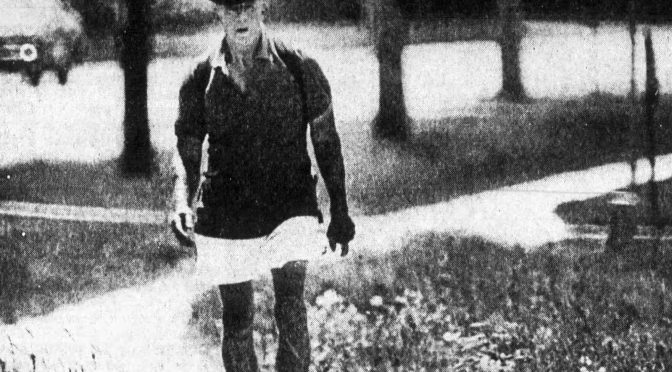
Fritz Bernshausen has walked 4,500 miles — just to deliver a message.

You might have seen him, two times a week, carrying the American flag from his south side Kenosha home, through Racine, to downtown Milwaukee.

What could be so important?

Fritz was front-page news in The Journal Times on August 29, 1987.

“I have a message,” Bernshausen said Friday on his way through Racine. “Walk America. That’s all it is. Two words — one verb, one noun.”

Bernshausen, 59, started walking the trail to Milwaukee about 3 1/2 years ago. In July, he started packing Old Glory to grab more attention.

“This is the 119th time I’ve done it,” he said. “I’m going to keep walking with that flag until I see some indication of a transposition of those two words — America walks.”

Bernshausen believes in foot power over gasoline power. You know, pedestrians over petroleum.

“America is in trouble all the world,” he said. “I figure the only way to solve that problem is to make America energy self-sufficient.”

Bernshausen said he is concerned about tensions in the Persian Gulf and Middle East, tensions he says cause two much risk and danger, just for the oil.

“A lot of boys are probably going to die for a barrel of oil,” said Bernshausen, a veteran of Army special forces from the Vietnam War. “It ain’t worth it.”

Fritz from his Vietnam days. (Johnson City Press photo)

“I’m concerned about my country,” he said. “I consider myself a public-spirited American…. This is my contribution to America.”

That contribution usually takes between 10 and 13 hours per trip, depending on the weather and how many people stop him along the way. If they ask, he gladly obliges.

“I got stopped by a policeman, I got stopped by a kid and a public works man,” he said, just before a photographer caught up with him. “I’m going to have to roll up the flag and run like hell.”

On occasion, Bernshausen packs some fruit to hand out to people along the route, which has become so familiar he said “I can almost do it blindfolded.”

Besides the flag, there is one other important bring-along.

“I carry some toilet paper,” he said, “just in case.”

While Bernshausen’s message is serious, the flag and the walking are good-natured ways of prodding citizens to think about fuel consumption.

“It’s real important to me,” he said. “It’s just too important (that) you can’t be serious.”

In that spirit, he quotes a phrase to sum up his effort: “Get off the wheels and on the heels.”

Once the long journey is finished, Bernshausen usually takes the bus home from Milwaukee’s Wisconsin Avenue. That was not the case on Friday. He met his daughter for dinner in Milwaukee and had to accept a car ride home.

A tough sacrifice for the cause.

(From the Aug. 29, 1987 issue of The Journal Times)

EPILOGUE: Fritz Albrecht Bernshausen died on March 13, 1993. He was just 64. He is survived by a son and four daughters. He requested that his  cremains be scattered from an airplane at 1,200 feet — a paratrooper’s jump altitude.

Remembering Lt. Edmund R. Collins, 100 Years Later

The rectangular grave stone sits quietly among thousands of others at Calvary Catholic Cemetery in Racine, Wisconsin. Its granite lettering pays tribute to the man who lies beneath it, but his real story has never been fully told. Lt. Edmund Richard Collins was a young lawyer and Knight of Columbus who went to war in 1917 as a leader of men. He returned home 100 years ago in a casket, a war hero with the distinction of being among the first U.S. soldiers to engage Communist Russians on the battlefield.

Most people do not know that an expeditionary force of American and Allied troops were diverted from World War I’s European theater and sent to North Russia and Siberia to fight the Bolsheviki, the Red Communist Russians who seized power during the Russian Revolution. It became known as the Polar Bear Expedition.

The grave of Lt. Edmund R. Collins at Calvary Catholic Cemetery, Racine.

American and Allied troops landed in August 1918 at Archangel, a key port on the White Sea in the northern part of European Russia. The Allies were commanded by British Maj. Gen. Edmond Ironside. When Allied forces took Archangel, the Bolsheviki fled south. Over the next nine months, American troops faced brutal conditions such as minus-20 degrees Farenheit temperatures and chest-high snow. Troops moved on foot and equipment moved via sled or sleigh. Before the winter set in, commanders urgently requested 1,000 pairs of skis, 5,500 pairs of snow shoes, and 7,500 pairs of moccasins to aid the men in advancing on the battlefield. Other requested equipment included 50 long cross saws and tongs for obtaining ice blocks for drinking water, and 100 sledges with dogs and harnesses.

Just as the Armistice ended World War I in Europe on Nov. 11, 1918, the action in North Russia was just getting started. The U.S. Army’s 339th Infantry Regiment brought more than 4,000 soldiers to the many battlefields across North Russia. They fought an enemy that was often well entrenched; defended by batteries of machine guns. The Bolsheviki used the deep snow as cover. U.S. patrols reported Bolsheviki suddenly emerging from massive snow banks to open fire on Allied troops or take prisoners.

A French-designed 155-mm long gun used in the North Russia campaign.

Allied troops fought and died in places with names like Obozerskaya, Chinova, Onega and Bolshie Ozerka (also spelled Bolshie Ozerki). Collins led his men in some of the fiercest fighting of the North Russia campaign. On March 17, 1919, Collins and some 30 men and one Lewis gun left Chekuevo and a traveled all night to reach Chinova. They advanced toward Bolshie Ozerka and had come within 1 verst (about two-thirds of a mile) of that place when they were fired upon by five or six machine guns at once. “It was only through the enemy’s high shooting that the whole detachment was able to slowly withdraw, crawling through the deep snow,” wrote Lt. Col. N.A. Lawrie in his battle summary.

On March 23, 1919, Collins led a detachment that engaged the enemy at Bolshie Ozerka. His men covered a front of about 300 yards, most of which ran through the woods. During the battle, the Bolsheviki laid down heavy machine gun fire, striking Lt. Collins and a sergeant from Company H of the 339th Infantry. Collins was shot through the lungs, while his compatriot suffered wounds to the shoulders and arms. Another lieutenant took command and advanced the troops 500 yards under heavy fire in waist-deep snow. The Allies returned heavy fire and held their ground for five hours until reinforcements arrived, according to a summary written by Capt. Richard W. Ballensinger of the 339th Infantry.

Troops and material were often moved by sled, pulled by horses or reindeer.

Badly wounded, Collins was evacuated to a dressing station. On March 24 he was being transported toward the hospital at Chekuevo. “He died from the effects of his wounds before he reached this station,” Ballensinger wrote. “I consider it my duty, since the weather permitted, to send his body at once to Archangel.” Lt. Edmund Richard Collins would be forever 28.

“Officers and men in this engagement did extremely well under trying conditions. I am sorry that I am forced to report the loss of a good officer.” –Capt. Richard W. Ballensinger

Collins was one of nearly 100 Americans killed as a result of combat before the campaign ended in May 1919. The men, who had been buried in various places around North Russia, were retrieved and sent to Archangel for transport home to the United States. Word of his son’s death reached Dr. William P. Collins in Racine over the weekend of April 5, 1919. The Racine Journal-News account said Collins died on March 29, five days after being shot. However, battlefield records indicate he died March 24, the same day he was wounded. The family would have to wait seven months for Collins’ body to return home for a funeral and final burial.

Page 1 of the Racine Journal-News from April 7, 1919.

Dr. Collins would have his heart broken again in November 1919, when a series of mistakes resulted in the wrong body being sent to Racine for burial. More than 100 soldiers’ bodies were aboard the Army transport Lake Daraga when it docked at Hoboken, N.J. on Nov. 12, 1919. Collins’ body arrived at the train station in Racine just before midnight on Nov. 19, surprisingly without military escort. When Collins’ casket was opened the next day, a mistake became immediately apparent. The man in the casket was much taller than Collins and was balding. Collins had a full head of hair. The man’s dog tag read, “Charles O’Dial 2021851.” It was the wrong body. Reports came in of incorrect soldier bodies being received in several other cities. Collins’ funeral was postponed.

In Carlisle, Indiana, the funeral and burial of Odial had already taken place. The body was exhumed and discovered to be that of Frank Sapp of Summitville, Indiana. A frantic Dr. Collins wired military officials in Washington. “Body sent to me belonged at Carlisle, Ind. Body exhumed at Carlisle at my request belonged at Summitville, Ind. Body exhumed at Summitville on my request was not right body,” Collins wrote. “All bodies so far proved to be misplaced. Is it not time to get busy?”

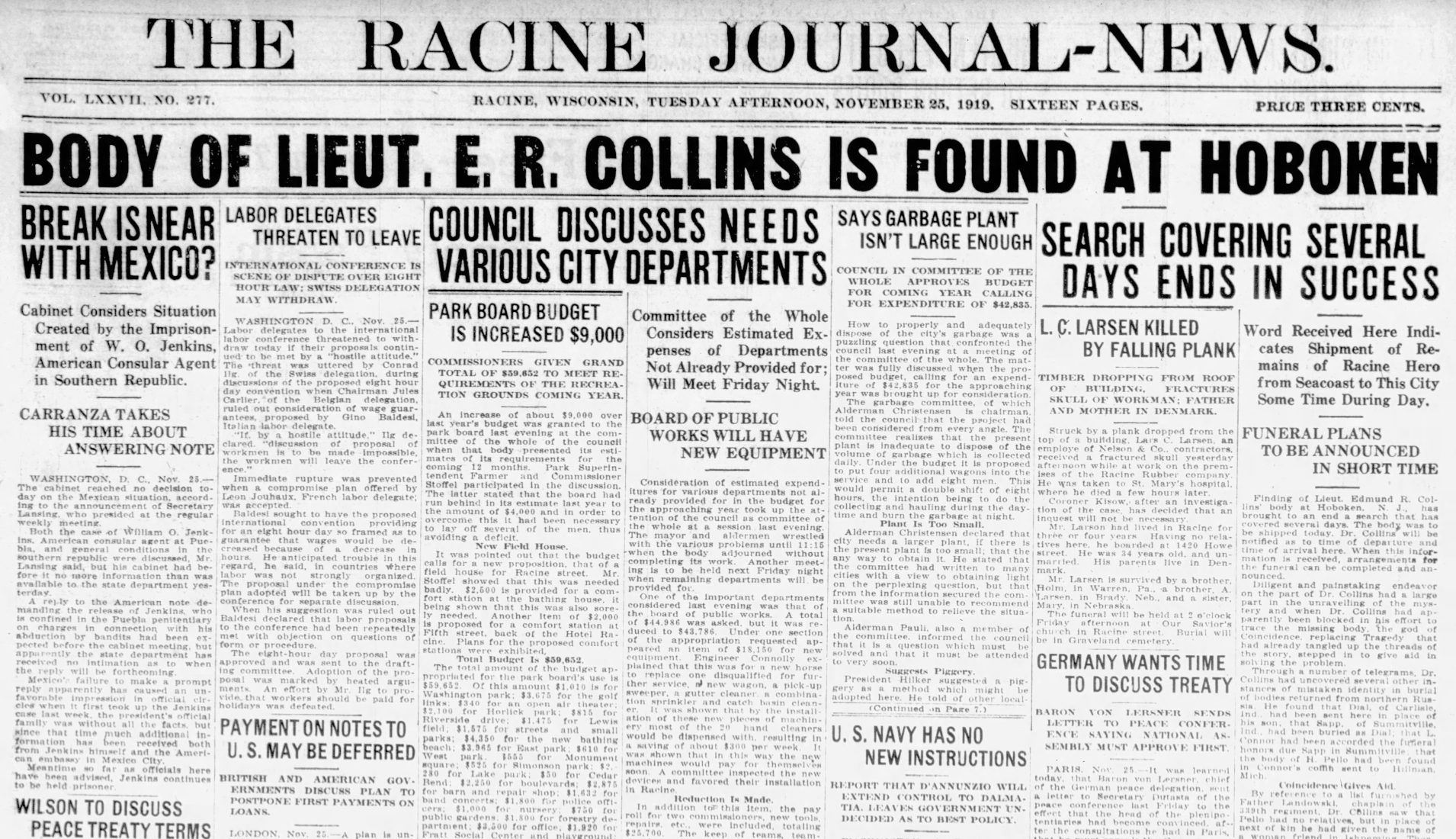
The Racine Journal-News announced the good news on Nov. 25, 1919.

The War Department issued a statement that did little to clear the air, blaming the mistakes on a rush to load the ships when pulling out of Archangel. In the end, Dr. Collins was the one to solve the mess after obtaining a list of the bodies on the ship and the numbered caskets. As it turned out, Collins’ body was still in Hoboken. On Nov. 25, the body was finally shipped via rail to Racine.

The tragedy took on another sad dimension when it was learned the officer who accompanied what was thought to be Collins’ body was killed in an auto crash in Chicago on Nov. 19, 1919. Further muddying an already confused story, the Chicago Tribune reported the dead man was Raymond R. Collins, the brother of Lt. Edmund R. Collins. However, according to U.S. Census records, Edmund Collins had no brother named Raymond, nor a brother who served in WWI.

Rev. John S. Landowski (Ancestry/Sara Ward)

The city of Racine was finally able to say goodbye to its fallen hero on Nov. 28, 1919. His funeral Mass was held at St. Patrick Catholic Church. “When the flag was sent to north Russia, Lieut. Collins unhesitatingly followed, and heroically gave up his life for his country,” said Father John Landowski, chaplain of the 339th Infantry Regiment. “When he was sent out on a hazardous expedition, he hesitated not, for he fully realized that the lives of his men depended on him. He recognized in that order, which proved fatal in the end, the call of the Most High. He fell in service, fell as a martyr of his land.”

©2019 The Hanneman Archive

Racine’s Rocky Has His Own Tale of Courage

By Joseph Hanneman
Journal Times

MILWAUKEE – Herman “Rocky” Espinoza has always wanted to be a police officer, but he will never get the chance to realize that dream.

“He’ll wear his police shirts every day,” says his mother, Deborah Exner of Monroe. “I even bought him a police siren for his bike.”

Rocky, 12, a Racine native, counts several police officers among his good friends and owns a toy gun and authentic handcuffs.

“He’s the good guy,” Exner said. “That’s probably straight from his mouth. He really holds that status so high.”

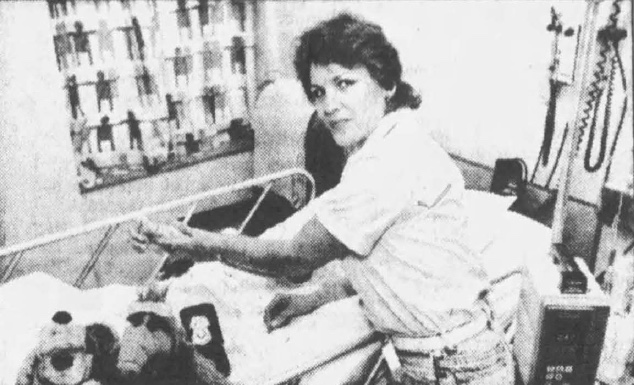
Exner_Hospital
Deborah Exner holds her son’s hand at Children’s Hospital of Wisconsin. (Racine Journal Times photo by Mark Hertzberg)

Rocky has always been a boy full of life, rarely complaining and always looking out for his mother. But for seven years, Rocky has battled an inoperable cancerous tumor growing at the base of his brain.

Time after time he fights back from the effects of the tumor, but there is little doctors can do for him.

“I don’t think I ever put it to him that he’s going to die,” Exner said. “I put it to him that this is just a kind of stopping ground. The next stop is heaven. He understands that.”

Despite the troubles that have fallen upon him, Rocky shows the courage and optimism many adults would envy. On Friday, he lay in his bed at Children’s Hospital of Wisconsin, resting.

Pinned to his hospital gown was one of his favorite police badges. On the cassette stereo, a song from his idol, John Schneider, played softly.

Nice and simple, just how he likes it.

Exner walked around the side of the bed, leaned over and kissed him softly on the cheek. She took his hand, looked into his half-open eyes and said a few reassuring words.

Behind Exner’s kind eyes and smile lie the thoughts of a woman who knows her son’s illness is beyond her control. All she can do now is make him comfortable.

Threat of death
Last month, Rocky had to return to Milwaukee after he began having seizures caused by the pressure the tumor exerted on his brain.

“All through the seven years there’s always been the threat of death,” Exner said. “No matter how bad the doctors thought it was, he popped out of it. (Doctors) don’t believe it. They are just amazed.”

The disease is to the point that doctors cannot keep up with an expanding cyst caused by the tumor. He has had three operations in three weeks to relieve the pressure.

Despite Rocky’s strong will to live, the cancer is exacting its toll.

“He’s been through so much,” Exner said. “I think he’s just real tired of fighting. He’s not giving up – he’s just tired.”

Rocky has trouble responding when people talk to him, but not always. “When I came into the room, I bent over and kissed him and said, ‘I love you,’ ” Exner said. “He said, ‘I love you, mom.’ “

Herman picked up the nickname “Rocky” because his cancer was diagnosed when the “Rocky” movies were popular. Besides, Exner said, he has been a real fighter.

“I took it worse than he did. I cried,” she said. “He took it really well. He has always just said, ‘It’s OK, mom.’ He knew he was real sick. He knew it was something he would have to deal with the rest of his life.

“He used to wake up in the middle of the night, just screaming with incredible headaches. I thought it was nightmares.”

When the headaches would not go away, she took Rocky to a Racine doctor, who referred him to a neurosurgeon at Children’s Hospital.

“Dr. Dunn could tell that the tumor was quite large,” she said. “He told me right away that there wasn’t any hope at all. There wasn’t anything they could do.”

But Rocky kept fighting back and giving himself extra time.

‘I’m not a wimp’
Outgoing and charismatic, Rocky lever lets on if he has any fear of his illness, relatives say. Before he went in for a recent operation, he told the doctors, “I’m Rocky – I’m not a wimp.”

Bob Pitts, of Mount Pleasant, Rocky’s uncle, said he told the boy to get better so they could arm wrestle. But Rocky couldn’t wait – he stuck his arm out and put up a pretty good fight.

“When he was first diagnosed,” Pitts said, “he wasn’t supposed to make it three months. He’s fighting every inch of the way.”

Rocky also enjoys riding a bicycle. “He was just learning to ride the bike again, then he had to come back here,” she said.

Schneider, who played Bo Duke on the “Dukes of Hazzard” television series, met Rocky at a Janesville concert last year and gave him his ID bracelet, which is now one of Rocky’s “most prized possessions,” Exner said.

On Friday, Schneider heard Rocky was back in the hospital and telephoned the family to check on him, relatives said.

A former student at Trinity Lutheran School, Rocky was not real big on the books, but he did like school.

Financial toll, too
Exner said she has accepted Rocky’s illness, but admits it has been hard for her in many ways.

“I don’t work, because I stay home and take care of Rocky,” she said. “It’s very hard. Right now I’m trying to find some ways of getting some more financial support.”

Rocky’s medical bills are paid mostly by Medicaid. But Exner has to pay her way to Milwaukee and back, which she said is difficult on a very limited income.

“Financially, I’m very strapped,” she said. “I couldn’t get any help to buy a car” and had to take a loan. “Now, I’m a little worried about that.”

‘Going to heaven’
The biggest toll is emotional.

“It’s hard to face it,” Exner said. ‘What puts me at peace with death (is) he is definitely going to heaven. That gives me peace.

“Sometimes I just wish I could trade places,” she said. “God has always made me a promise that says ‘I’m not going to push you any more than you can handle.’ “

Exner’s adjustment to Rocky’s terminal illness has included hysteria, a lot of tears and anger. But she said her main concern is seeing that Rocky does not suffer.

“If his life is going to hurt him any more, with the love I have for him, I’d rather see him at peace in heaven, ” she said.

“If he does die, I guess a part of me will die too. But I don’t want to be selfish. He’s been through enough. We’ve done as much as we possibly can and now its time to stop.”

Exner’s pain seemed well hidden on Friday. She and her relatives were able to laugh and recall their favorite stories about Rocky. She knows the pain is not over.

“When he actually does die, I think I’m going to fall apart,” she said.

Instead of focusing on the bad things that have happened, Exner counts the good times she has had with her son.

“I’ve had 12 of the hardest but most wonderful years with that young man,” she said. “I’m just thankful for that.”

She said the mother-son bond between them could not be stronger.

“I think that kid is a miracle,” Exner said. “I’m just proud to be his mom. I don’t know what I did, but I’m glad he’s mine.” ♦

– Originally published on Page 1 of the October 10, 1987 edition of the Racine Journal Times. View the original news pages.


Headline_DIes

By Joseph Hanneman
Journal Times

Herman “Rocky” Espinoza, the former Racine boy who battled an inoperable brain tumor for several years, died Sunday in a Milwaukee hospital, wearing his favorite police shirt and badge.

Rocky, 12, who dreamed of growing up to be a police officer, died in his sleep Sunday morning at Children’s Hospital of Wisconsin.

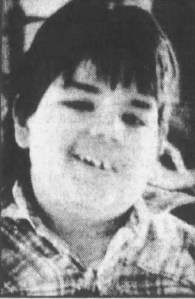
Rocky
Herman “Rocky” Espinoza

“I was able to hold him, just like I wanted,” said Deborah Exner, Rocky’s mother, who now lives in Monroe. “When it came right down to it, it was just Rocky and I.”

Exner said she was sleeping on a cot next to Rocky’s bed when a friend noticed his breathing getting shallow. Exner said she got up, put music from Kenny Rogers and John Schneider – two of Rocky’s favorites – on the cassette stereo, then held his hand and waited.

Rocky wore the police uniform Exner had trouble getting off him at home. He will be buried in it, she said.

“l just held his hand and tried to talk to him,” Exner said. “I believe he was very, very peaceful ….I talked him into heaven.”

Diagnosed with cancer at age 5, Rocky was in and out of the hospital many times, fighting the effects of a cancerous brain-stem tumor. Only expected to live months after the tumor was diagnosed, Rocky bounced back time and again

Most every day he would wear the police shirt and badge given to him by a family friend. He also owned a toy gun and a pair of authentic handcuffs.

Even in the hospital, dressed in only a green gown, he wore one of his badges. This time, it seems, the badge was one of courage.

He got the nickname “Rocky” because the Sylvester Stallone movies were popular at the time and because his family felt he was a fighter. Exner said Rocky dealt with the disease without much fear.

“He was a very brave boy,” she said. “There were no tears.”

Rocky’s corneas were donated to the Lion’s Club eye bank and doctors removed his brain to study the large tumor they were unable to stop, she said. Funeral arrangements are pending in Racine.

Relatives described Rocky as an a eternal optimist who was always looking out for other people. On Sunday, Exner recalled one such occasion.

Rocky was being examined at the Shriner’s Hospital in suburban Chicago, Exner said, when the doctor asked to speak to her in the hallway.

“Rocky just spoke up and said, ‘Wait a minute, I’ve got something to say,’ ” Exner said. ” ‘It doesn’t matter if you can do something for me. You just keep on helping all the other kids.’ “

Exner said although the seven-year ordeal has been painful for her, she was doing pretty well on Sunday.

“I’m very much at rest right now,” she said. “He went out like a champ and I was proud of him.”

Bob Pitts of Mount Pleasant, Rocky’s uncle, said, “I’m going to miss him very much. I think he was just a brave little boy. Now he’s at peace.

Late last week, Exner sat in the cafeteria at Children’s Hospital and described how Rocky would wake up screaming in the middle of the night, with what she thought were nightmares. When his headaches persisted, they sought medical help and the tumor was diagnosed.

At times on Friday, Exner laughed when recalling the good times she had with Rocky. At other times, pain seemed to well just beneath the surface when she discussed their pending separation.

“I get real angry sometimes,” she said. “At first I think, ‘Why me? Why not someone else?’ Then I get realistic about it, because who would I want to wish that on? Nobody.”

Exner, who described her son as “a miracle,” said she wants to write a book about the experience.

Family members attributed Rocky’s long survival with the massive tumor to a strong character, medical help and love.

“I think he made it this long because of his doctor (David Dunn) and this hospital,” Pitts said.

Exner thought about that statement for a moment, then added her own reason Rocky fought so hard:

“Because he loved me,” she said. ♦

– Originally published on Page 1 of the October 12, 1987 edition of the Racine Journal Times. View the original news pages.


Headline_Guard

By Joseph Hanneman
Journal Times

Herman “Rocky” Espinoza never realized his dream of becoming a police officer, but on Thursday, local police will give him a funeral escort usually reserved for their distinguished comrades.

At least four squad cars and officers from the Racine Police Department, the Racine County Sheriff’s Department and the Sturtevant Police Department will escort Rocky’s procession from the funeral home to the church and cemetery.

After reading newspaper accounts of Rocky’s seven-year fight with a brain-stem tumor, several officers had planned to present him with police badges and hats Monday at Children’s Hospital of Wisconsin.

Rocky died early Sunday in his mother’s arms.

Deputy Chuck Kwapil said officers then decided on the escort “to have an opportunity to show how he touched our lives.”

“I think it was the bravery,” Kwapil said. “He was a fighter all the way through. He cared about other people and I think that was touching.

“He would have been one heck of a policeman,” Kwapil said “It would have been nice to work with someone like that.”

Racine police provided an Officer Friendly hat and badge that will be placed in Rocky’s casket. The sheriff’s department will also present the family with an officer’s hat and badge.

“It has just been unbelievable,” said Bob Pitts, Rocky’s uncle, of the police response. “I think he would be the happiest little boy on earth.”

Pitts said when the family heard of the police offer of an escort, “We all had tears in our eyes.”

Pitts said Rocky “was always the good cop. To have a will that strong is something.”

A Racine native who most recently lived in Monroe, Rocky spent nearly every day at home wearing a Sturtevant police shirt he got from a family friend.

When a relative recently gave Rocky a bicycle, his mother bought him a police siren. Even when he was struggling for his life in the hospital, his favorite badge was pinned to his hospital gown. And the day he died, he wore the uniform in which he will be buried.

“I don’t know of anybody that read (news articles) that couldn’t be moved by his courage, what he was facing and his concern for others,” said Racine Police Sgt. Thomas Cooper.

“If somebody cared that much about being a police officer, it’s the least we can do, to show him the same respect we would show an officer,” said Sheriff’s Deputy Jim Aiello.

“I’ve never come across anything like this, and I’ve been on this department 14 years,” said Sturtevant Police Sgt. Robert Mallwitz.

“There you’ve got a real, legitimate hero.”

The escort will begin about 10 a.m. at Strouf-Sheffield Funeral Home, 1001 High St., then proceed to Trinity Lutheran Church, 2065 Geneva St. After a funeral service, the procession will head to Calvary Cemetery, 2510 Kinzie Ave. ♦

– Originally published on Page 1 of the October 14, 1987 edition of the Racine Journal Times. View the original news pages.


Rocky2

Racine area law enforcement officers form an honor guard for Rocky Espinoza. (Racine Journal Times photo by Mark Hertzberg)

Headline_Dream

By Joseph Hanneman
Journal Times

Herman “Rocky” Espinoza did not win his seven-year struggle with an inoperable brain tumor, but on Thursday, his dream came true.

The buoyant 12-year-old’s strongest wish in life was to serve the public as a police officer, but terminal cancer ended his life Sunday. Even in death, his wish was not forgotten.

Dressed in a blue police shirt, tan pants, badge, handcuffs and holster. Rocky was escorted to Calvary Cemetery by a procession of 13 law enforcement officers and eight squad cars.

The officers, representing the Racine County Sheriff’s Department and police from Racine, Mount Pleasant, Sturtevant and Caledonia, said they were not just honoring a courageous boy, but one of their own.

“He’s one of us now,” said Sturtevant police Sgt. Robert Mallwitz, a member of the escort. “It was just an honor to help a kid realize a dream.

“I was very proud, very honored to be there,” Mallwitz said.

At the funeral home, one officer stood at attention in a silent watch outside the visitation room. Others passed through the room in a show of solemn respect.

The procession to the church and cemetery was complete with a line of squad cars with emergency lights flashing. Nobody would have been prouder than Rocky.

At the cemetery, a police honor guard stood watch as Rocky was moved to his final resting place under a sugar maple. Atop the casket was perched a lone hat with the Racine Police Department logo on the front.

Inside the casket was Rocky’s collection of badges and hats from several other police departments. Even a teddy bear tucked inside wore a sheriff’s hat and miniature badge.

These were the symbols of a child’s very existence.

The officers who attended did not know Rocky, but the pain of loss was visible in their faces. They knew what their presence meant.

“We’re thinking that his dream did come true – finally,” said Racine Patrolman Scott Barrows, known to many children as Officer Friendly.

“He probably did see us there,” said Caledonia police dispatcher Pam Vanko. “I was glad that we could kind of help him with that dream.”

Mount Pleasant Patrolman Steve Swanson said he was proud that a young boy had such strong feelings for police.

“He came as close to being an officer as anyone has come without being sworn,” Swanson said. “(We) were in awe of his courage and strength.”

The escort was a fitting end to the story of a boy who, from the time he knew what the word police meant, wanted to be an officer. Despite a cancer that for seven years grew in his brain stem, Rocky spent his days and nights thinking of a time when he could wear the real uniform.

Officers in attendance Thursday believed Rocky wore the real thing.

“If he would have pulled through, he would have been one hell of a cop,” Mallwitz said. “It just seems unfair, a kid that’s so good gets taken so early.”

“I don’t think I could have gone through what Rocky went through for as long as he went through it and have the attitude he had,” Swanson said.

Students from Rocky’s former school, Trinity Lutheran, said goodbye with several songs at a funeral service. The school’s bell choir played music that for a brief moment drew a smile from Rocky’s mother, Deborah Exner.

The Rev. Patrick Baynes, of Trinity Lutheran Church, summed up what many in the church were undoubtedly feeling.

“Death can leave us helpless, because for once there is nothing we can do,” Baynes, said. “No treatments. And more frustratingly, no more words.” ♦

– Originally published on Page 1 of the October 16, 1987 edition of the Racine Journal Times. View the original news pages.


Exner
Deborah Exner visits the grave of her son, Rocky, at Calvary Catholic Cemetery. (Racine Journal Times photo by Paul Roberts)

Headline_Remember

By Joseph Hanneman
Journal Times

Deborah Exner knelt over her son’s grave, quietly arranging the fresh flowers she placed in a decorative orange jack-o’-lantern.

She carefully plucked blades of grass from around the small wooden cross that marks the site, pulled a daisy from the planter and slowly walked away.

The mixture of pain and acceptance on her face went a long way toward explaining what her life has been like for the past eight years.

For the mother who one year ago lost her only son, Rocky Espinoza, to an inoperable brain tumor, it is still hard to come to Calvary Cemetery. “I don’t go to the cemetery very often,” she said. “It doesn’t do anything for me at all. It’s a very empty feeling.”

Rocky died of cancer after a seven-year fight with the slow-growing tumor that expanded at the base of his brain.

An optimistic 12-year-old Racine native, Rocky lived a dream of one day becoming a police officer. He wore a police shirt, hat and holster every day at home. His bicycle was proudly outfitted with a siren. Even while at Children’s Hospital of Wisconsin, he wore a badge on his green gown.

But despite his strong dreams, the cancer proved to be stronger, claiming his life on Oct. 11, 1987.

Racine County’s law enforcement community was touched by Rocky’s respect for the badge. At the visitation service, dozens of Racine police officers filed past the boy’s casket during shift change.

And 13 officers gave him a police escort to the cemetery and a full honor guard – the kind of respect usually reserved for fallen colleagues.

Rocky was buried in his favorite police uniform.

Exner said she saw her son’s death coming, but was not prepared for the pain that would rack her existence and lead her to question the worth of her own life.

“I don’t think I really believed it was going to happen,” she said. “I felt, ‘It can’t happen to us – we’ve succeeded too many times.’ “

Those successes included Rocky’s recovery from numerous operations to relieve pressure from the tumor.

Exner recalled one day after Rocky was home from the hospital, he fought with determination to push his “police” bicycle up a steep hill in order to keep riding. Dreams of being an officer “motivated his whole life,” she said.

But trips to the hospital got more frequent. The tumor began exerting a heavy toll. One day, Exner told doctors enough was enough. She told her son it was OK to die.

Grieving process
Nearly one month after Rocky died in his sleep, that decision sparked doubts and guilt in Exner’s mind and began a tumultuous grieving process.

“I really felt like I was selfish,” Exner said. “I should have kept on doing everything I possibly could.

“Sometimes I even felt like he cheated me,” she said. “He shouldn’t have went, he should have fought harder “

After seven years of caring for a terminally ill child, the death left Exner without direction.

“I didn’t know what I was supposed to do with my life, and I still don’t,” she said. “He was all I knew.”

In November 1987, Exner hit rock bottom. All the calm she experienced directly after Rocky’s death gave way to painful emotions and thoughts of suicide.

“I felt there was nothing left in this world for me,” she said. “Everything I fought for and lived for was gone.”

Guilt continued to plague her.

“Did I do the right thing?” she asked rhetorically. “I felt like I had been selfish, because I wanted it to be over. I felt it was time to just stop and let God take over.”

Period of escape
There was a period she didn’t want to think about Rocky or be near children or hospitals.

She sought to have her fallopian tubes tied, but her doctor asked her to wait. She backed away from the idea and now says she might someday adopt children.

It took months to realize there was no blame to be laid for the cancer, Exner said. She became comfortable that she made the right decisions.

“The doubt is still there at moments,” she said. “But Rocky and I had this understanding about the whole thing. He trusted me and I trusted him.”

The healing has come slowly, but Exner said the grief is starting to ebb. She’s now able to remember the good times and can read news articles about Rocky without crying.

On his birthday last month, she bought toys and gifts – the kind Rocky liked – and gave them to sick children at a hospital in Monroe, where she now lives.

She cleaned out his room and donated much of his belongings to charity. She saved some favorite mementos, however.

‘Not really gone’
“Whenever I still feel real, real low, I’ll go in and open the trunk and look through that stuff,” she said. “I realize he’s not really gone, he’s inside of me.

“I think, ‘If I could have one more hug, or say, I love you, one more time,’ ” she said.

While it was Rocky’s illness and death that led to the pain Exner continues to endure, he may well be the key to healing.

Sense of pride
“The main thing that keeps me above water is that his life was for the good,” Exner said. “It makes me proud, he was such an understanding and caring child. It makes me feel I did my job as a mother. I don’t think I’ll ever meet anyone like him in my life.”

Asked whether she was starting to heal, Exner looked away in careful thought, seeming for a long moment to be somewhere else. “I feel more stable. I don’t think Rocky would have wanted me to quit,” she said. “He was always proud of me – it always made me feel good. I still have to go on.”

The future might well hold opportunities for working with the terminally ill and their families, she said. But for now, Exner is trying to remember.

She wants to someday write a book about her son and what they went through together. But first there are questions and conflicts to be resolved.

“I’m still searching for the reason all this happened to me,” she said. “I couldn’t see it being for nothing.” ♦

– Originally published on Page 1 of the October 16, 1988 edition of the Racine Journal Times. View the original news pages.

Armless Musician Strikes Emotions

By Joseph Hanneman
Journal Times

Tony Melendez has serenaded Pope John Paul II and performed in front of thousands, but he says he is still shocked by the emotional reaction from the people he touches with his music.

“Some of the people’s responses are so touching,” Melendez said. “I can’t believe the response Some come crying and give me a hug. Some want to kiss the same cheek the pope kissed.”

The strong reactions are not just because Melendez, 26, sings with a smooth tenor voice, or that he plays nearly flawless acoustic guitar.

JournalTimes_Melendez_1988_
Tony Melendez plays flawless guitar with his feet. (Racine Journal Times photo by Paul Roberts)

People are inspired because Melendez was born without arms and plays guitar with his feet, in a seemingly effortless manner.

Whole new world

“The music has just opened up a whole new world for me,” Melendez said before a performance Saturday night at St. Rita’s School, 4433 Douglas Ave.

“It’s been scary,” he said of the reaction he gets. “I’m not used to that overwhelming thrust toward me.”

Melendez, of Chino, Calif., performed for about 200 people at St. Rita’s, combining Christian music, storytelling and a healthy sense of humor.

Melendez is at ease with the fact he has no arms and does not consider himself handicapped. He even calls his company “Toe Jam Music.”

He told the group he stopped using prostheses because “my feet could do it so much faster quicker, neater. People ask me, ‘Do you eat with your toes or your feet?’ ” he said. “I eat with my mouth.”

With the guitar flat on the stage before him, Melendez’s bare feet glided up and down the strings effortlessly, while he sang about hope, inspiration and God.

Crowd’s response

As he walked to and from the stage, people pulled him aside for a hug, or kissed him like he was their own son.
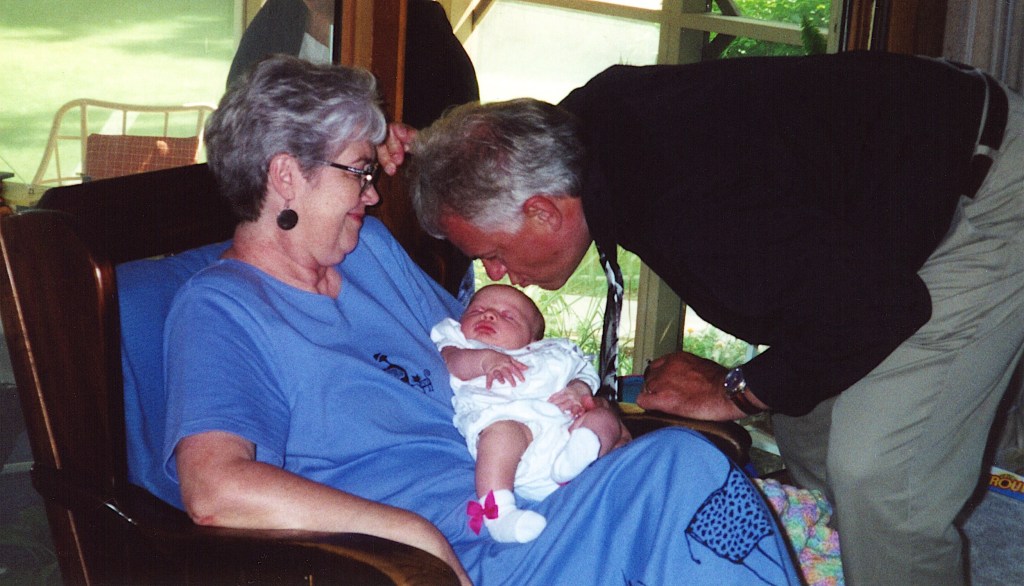
“It still to me is very surprising,” he said. Crowd response comes from “a lot of young, and old. It’s really neat.”

Melendez earned national recognition last year when he played and sang for John Paul II– a performance that so moved the pontiff he touched Melendez’s legs and kissed his cheek.

Eight months later, Melendez recalls that performance as “a moment in my life I never thought would happen.”

John Paul’s reaction was nothing short of shocking to Melendez.

“I thought I was going to sing, then ‘clap, clap, clap and go home,” he said. “It really was a true blessing for me when he came over and gave me that kiss.”

In the time since, Melendez has been to 29 states, sometimes doing three performances a day.

Melendez was born in Nicaragua in 1962. His mother took thalidomide, an anti-nausea drug that caused the birth defect he has overcome. He spent much of his life in schools for handicapped children, but decided as a high school sophomore he wanted to be in public schools.

It was at about that time, when he was 16 he first tried playing his father’s guitar, after learning how to tune it with his feet.

“I did it and it just worked, and I kept at it,” he said. “I didn’t consider it practice. I loved it so much, I played five to six hours a day.”

While still getting a case of stage fright now and then, Melendez said the music helped him grow. He now promotes a pro-family, pro-love message during performances.

Music opens doors

”Once I start, it just automatically flows,” he said “Once I’m up there, something just takes over.”

Music “opened a lot of doors,” he said. “It’s given me a little more sense of security.

“I think they (spectators) sometimes go home saying, ‘If he can do it, I can do it,’ ” Melendez said. “When people go home, they feel a little bit better about themselves.”

Jose Melendez Jr., Tony’s concert manager, told the St. Rita’s crowd he learned things by watching his brother. He said one day when the pair was younger, he wanted to play Frisbee, but could not bring himself to ask, for fear he would hurt Tony’s feelings.

But Tony picked up the Frisbee in his toes and threw it, striking Jose in the face. It was then, Jose said, he realized his brother’s strength.

“That’s the first time I saw his arms and his hands.” ♦

– This article first appeared in the May 8, 1988 edition of the Racine Journal Times. View the original newspaper page.

Postscript: Tony Melendez continues touring, recording music and sharing his story around the world. He performed for Pope John Paul II four more times. He has recorded a number of contemporary Christian albums. He is married and lives in Branson, Missouri.

Further Reading: Tony Melendez Web Site

Escape Artist Makes Quick Work of Racine Jail

Escape Velocity:
Trickster Makes Short Work of Racine Jail

By Joseph Hanneman
Journal Times

Most husbands gave candy or sent flowers to their wives on Valentine’s Day. Todd Martin escaped from jail.

The 23-year-old Houdini-style escape artist from Sheboygan slipped out of two pairs of handcuffs, a belly chain, a canvas mailbag, three iron-bar jail doors and a locked wooden door Wednesday at the Racine City Jail.

Martin_Cuffed
Racine Police Chief Karl Hansen handcuffs Todd Martin at the Racine City Jail on Feb. 15, 1990. Racine Journal Times photo by Paul Roberts.

And it took only seven minutes.

After defeating the final lock at the jail Wednesday, Martin chatted with reporters and gave his wife, Amara, a Valentine’s kiss. Another day, another jailbreak.

Relatively long time

“That’s the longest I’ve ever been held,” said Martin, who has broken out of the pokey some dozen times before. “You sure can be proud of yourselves.”

The man who calls himself Anthony the Great wore a black stretch body suit and cape as he was led to his cell, trailed by dignitaries that included Mayor N. Owen Davies, Sheriff Robert Rohner and Alderwoman Dorothy Constantine.

Martin_TIedUp
Martin is tied inside a canvas mailbag at the Racine jail. Racine Journal Times photo by Paul Roberts.

Alderman Michael Vidian patted Martin down and checked his hair and mouth for tools. Police Chief Karl Hansen put two pairs of handcuffs on Martin, and shackled his forearm to a belly chain. He was then placed in a canvas mailbag and locked in the cell at exactly 2:18 p.m.

The gathered throng of local officials, reporters and photographers waited in the hall outside the jail as Martin plied his trade. All they could hear was the rattle of each lock as he made his way closer.

Then, at 2 25 p.m., he emerged.

“I’m glad we’re closing the jail on the first of April,” Hansen quipped. The jail will be gutted to make way for a new communications center and city prisoners will be transferred to the county jail.

Martin said the lock on the jail cell was the most difficult to open, because it had a weighted spring that held down the lock hook.

“It’s difficult to manipulate a lock like that,” he said.

Try it in a coffin

The escape was probably a yawner for Martin, who escaped from a locked coffin in 1988 after being tossed from an airplane 13,500 feet above Sandwich, Ill.

When he was 18, he was sealed in a hole-riddled coffin and pushed into the Sheboygan River while covered in 20 pounds of chains and 500 pounds of rock. He escaped in 50 seconds.

“I think I did a good job,” he said matter-of-factly. “Two hours would have been a good time.”

After the escape, Martin posed for pictures in the locked cell and recreated parts of the escape for a national television crew. When the last photo had been snapped, he called for the jailer.

“Now I need a key,” he said. ♦

EscapeVelocity
This article first appeared on Page 1 of the Racine Journal Times on February 15, 1990.

Postscript: Now age 51, Martin continues to perform under the name Anthony Martin (Anthony is his middle name). He is also a Christian evangelist. In 2013, he published a book, Escape or Die: An Escape Artist Unlocks the Secrets to Cheating Death.

– See the original Journal Times page from February 15, 1990