DACHAU, Germany — Forty-six years after it was liberated from Adolf Hitler’s brutal regime, an unsettling quiet hangs over the massive grounds of Germany’s first Nazi concentration camp.
A cool wind rustles through the dead leaves of last season. It whispers what seems to be an audible tale of the cruelty and atrocities committed here between 1933 and 1945.
Village near Munich
The picturesque village of Dachau, a 1,200-year-old community in southern Bavaria, is located only a few miles northeast of Munich. The area has a rich culture of its own, but the world will always associate Dachau with death.
Dachau records show 31,957 registered deaths between 1933 and 1945, but many historians believe the number is much higher. The tally does not include the scores who arrived dead in train cars from other camps.
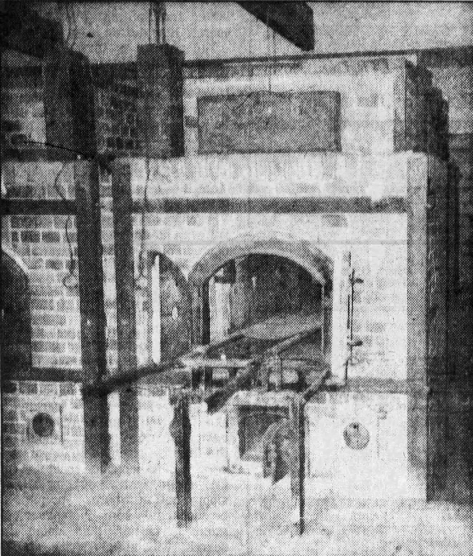
Dachau’s ovens are a stark reminder of the tens of thousands of victims who were cremated at the concentration camp. (Photo by Joe Hanneman)
When American soldiers liberated the camp on April 29, 1945, there were bodies all over the camp. A mass grave was established near the camp, where about 4,000 people were buried shortly after liberation.
The concentration camp site, on the northern outskirts of Dachau, has been maintained by the Committee International de Dachau as a permanent memorial and reminder of what happened here.
Directly inside the original electrified barbed wire fence is a museum that opened in 1960. The rest of the site opened as a memorial in 1965.
The museum holds haunting pictures of the torture, starvation and death that were everyday occurrences here. A stunning film was confiscated from German soldiers when the Allies liberated the camp.
In the center of the museum is a heart-rending picture of an emaciated prisoner laying flat on his stomach, arms outstretched, The look on his face seems like a silent cry for help.
Gruesome Pictures
Other pictures show stacks of corpses waiting for incineration at Dachau’s two crematorium buildings, piles of valuables pilfered from prisoners, and two men — hung upside down — being beaten by smiling Nazi SS guards.
There are also depictions of the cruel experiments carried out by the SS, which stands for Schutzstaffel — Hitler’s elite police. Some prisoners were put in special suits to determine how they reacted to depressurization.
An original torture rack stands in the center of one room of the museum.
In a display case hang examples of the identification badges prisoners were forced to wear. Jews wore stars of David. Non-German prisoners wore colored chevrons: green meant professional criminal, black meant “asocial,” violet was for “Bible inquirers,” and pink was for homosexuals.
Outside, the cement foundations of the 34 barracks stretch for hundreds of yards. The barracks were decrepit and rotting when the camp was liberated. They were torn down, but two were rebuilt as part of the memorial.
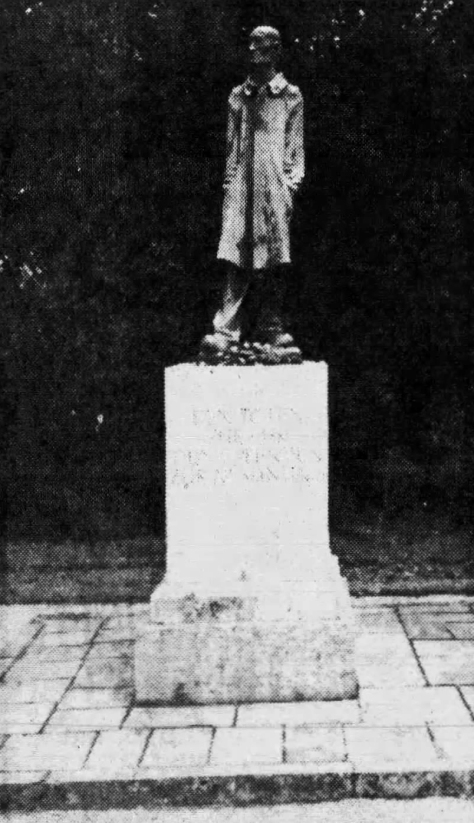
The statue of the unknown victim stands right outside the crematorium. (Photo by Joe Hanneman)
Each building was designed for 80 prisoners, yet at the height of the war, some held more than 400.
In the courtyards between the barracks, prisoners once stood for roll call. Sometimes, they stood motionless for hours in rain or snow, the so-called “standing torture” that claimed many lives.
Even the dead had to show up for roll call, dragged by compatriots who were forced to make sure the deceased were counted each day.
Ironic motto
The original front gate still open-, adorned in iron by the camp motto – Arbeit Macht Frei – a cruelly ironic phrase that roughly means, “Work shall make you free.”
Just outside the perimeter fence are the two crematorium buildings that were once so busy that rotting bodies stacked up in a gruesome backlog.
The oven doors stand open. On the hinge of one door hangs a single, drying rose. A wreath hangs on an oven in the adjacent room.
Prisoners who died here were often shot to death. Others died of disease or torture. No one was gassed to death at Dachau, although a shower room for gassing had been installed. Prisoners marked for gassing were sent to Linz, Austria.
Several chapels were erected on the site in the 1960s, as if in an attempt to heal the destruction wrought at the camp. The Carmelite order of nuns built a convent here.
A huge granite memorial near the entrance sums up the reason the camp has been maintained for so long:
“May the example of those who were exterminated here between 1933-1945 because they resisted Nazism help to unite the living for the defense of peace and freedom, and in respect for their fellow men.” ♦
– This article originally appeared in the April 28, 1991 issue of the Racine Journal Times. View the original news page.
Escape Velocity:
Trickster Makes Short Work of Racine Jail
By Joseph Hanneman
Journal Times
Most husbands gave candy or sent flowers to their wives on Valentine’s Day. Todd Martin escaped from jail.
The 23-year-old Houdini-style escape artist from Sheboygan slipped out of two pairs of handcuffs, a belly chain, a canvas mailbag, three iron-bar jail doors and a locked wooden door Wednesday at the Racine City Jail.
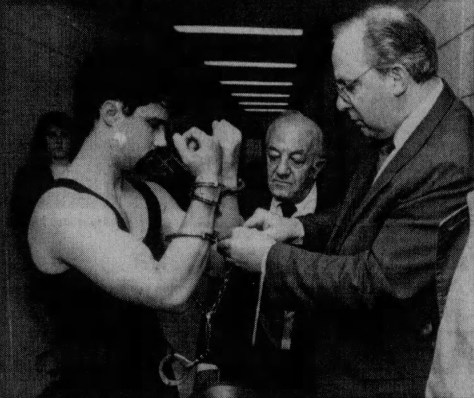
Racine Police Chief Karl Hansen handcuffs Todd Martin at the Racine City Jail on Feb. 15, 1990. Racine Journal Times photo by Paul Roberts.
And it took only seven minutes.
After defeating the final lock at the jail Wednesday, Martin chatted with reporters and gave his wife, Amara, a Valentine’s kiss. Another day, another jailbreak.
Relatively long time
“That’s the longest I’ve ever been held,” said Martin, who has broken out of the pokey some dozen times before. “You sure can be proud of yourselves.”
The man who calls himself Anthony the Great wore a black stretch body suit and cape as he was led to his cell, trailed by dignitaries that included Mayor N. Owen Davies, Sheriff Robert Rohner and Alderwoman Dorothy Constantine.
Martin is tied inside a canvas mailbag at the Racine jail. Racine Journal Times photo by Paul Roberts.
Alderman Michael Vidian patted Martin down and checked his hair and mouth for tools. Police Chief Karl Hansen put two pairs of handcuffs on Martin, and shackled his forearm to a belly chain. He was then placed in a canvas mailbag and locked in the cell at exactly 2:18 p.m.
The gathered throng of local officials, reporters and photographers waited in the hall outside the jail as Martin plied his trade. All they could hear was the rattle of each lock as he made his way closer.
Then, at 2 25 p.m., he emerged.
“I’m glad we’re closing the jail on the first of April,” Hansen quipped. The jail will be gutted to make way for a new communications center and city prisoners will be transferred to the county jail.
Martin said the lock on the jail cell was the most difficult to open, because it had a weighted spring that held down the lock hook.
“It’s difficult to manipulate a lock like that,” he said.
Try it in a coffin
The escape was probably a yawner for Martin, who escaped from a locked coffin in 1988 after being tossed from an airplane 13,500 feet above Sandwich, Ill.
When he was 18, he was sealed in a hole-riddled coffin and pushed into the Sheboygan River while covered in 20 pounds of chains and 500 pounds of rock. He escaped in 50 seconds.
“I think I did a good job,” he said matter-of-factly. “Two hours would have been a good time.”
After the escape, Martin posed for pictures in the locked cell and recreated parts of the escape for a national television crew. When the last photo had been snapped, he called for the jailer.
“Now I need a key,” he said. ♦
This article first appeared on Page 1 of the Racine Journal Times on February 15, 1990.
Postscript: Now age 51, Martin continues to perform under the name Anthony Martin (Anthony is his middle name). He is also a Christian evangelist. In 2013, he published a book, Escape or Die: An Escape Artist Unlocks the Secrets to Cheating Death.
This was a day I’d long dreaded. I knew it was coming, and prepared for it the best I could. But I feared it still, because I did not have an answer for the question it posed. How do I — how could I — say goodbye to our family home?
I walked through the now nearly empty house and I still had no answer. So much had happened during the nearly 14 years we lived here. Our third child joined us here. They all grew up here. Our oldest went off to college from here. I started a home-based business here; a business that failed during the long recession. That’s what eventually brought me to this day, just a short time before foreclosure would take it all away.
Stevie, Ruby and Samantha on the first day of school.
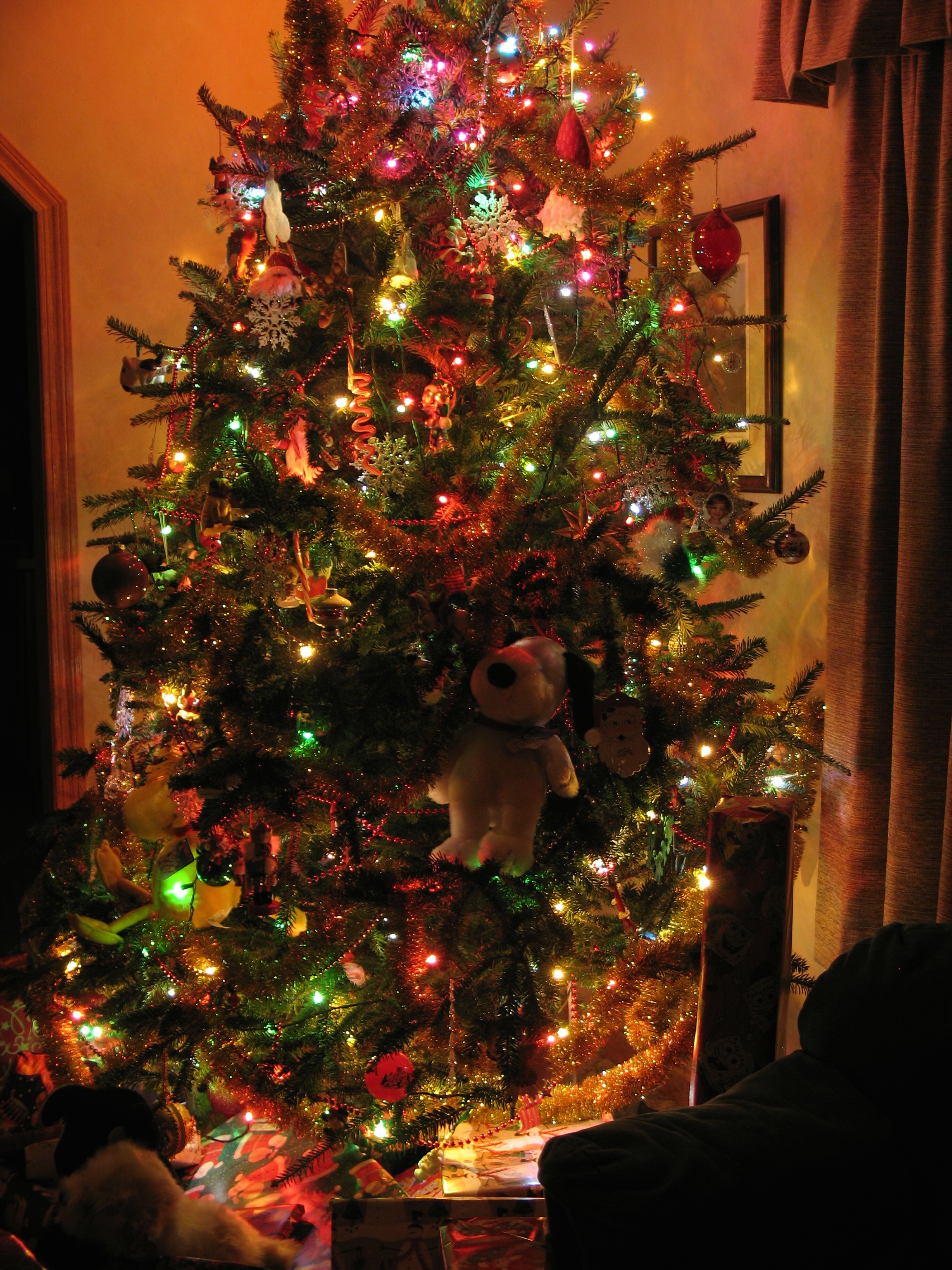
I stood in the front entryway and listened. Nothing. The quiet was almost deafening. A few boxes and odds and ends were scattered about, but very little remained of the home I loved. This is not how a home is supposed to look. I’m struck by how cold and empty it is. No pictures on the walls. No dogs running to the window to bark at the mailman. No children watching a favorite movie. No charcoal grill cooking steaks out on the deck. No carefully decorated Christmas tree in the corner of the family room, sending out a warm glow into the night. No family saying grace at the dinner table. This is not how I want to remember our home.
I start to walk the house. Almost like a projected movie, the memories flowed, right before my eyes.
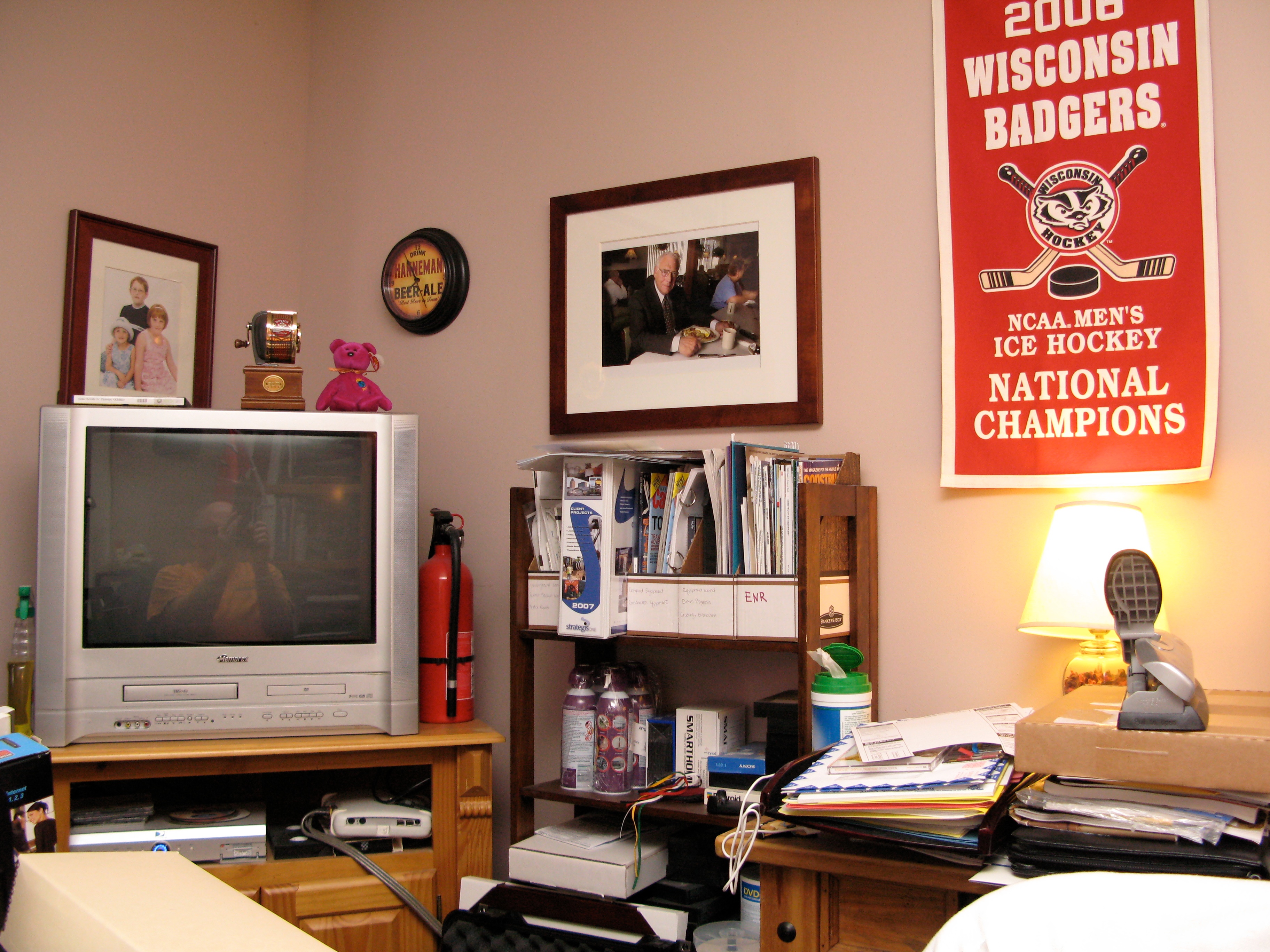
The cluttered brilliance of my home office.
I peered outside the small window to the left of the front door. I can almost see my late father coming up the sidewalk with a broad smile and saying, “Hello, Jofus” (that was his little word play on my given name after St. Joseph). September 15, 2006. That was the last time he was here. The sun glints off his silver hair, he waves, and is gone.
I turn and start to head up the stairs to the second floor. The paint color is darker on a large section of the wall. For most of the time we lived here, a giant quilt hung on the wall, embroidered with the saying, “In a House with Love, All things are Possible.” The carpeting on a section of the landing looked new where a small cherry bookcase sat. The case had belonged to my Grandpa Carl. On top of the case I had a shrine with candles, a large crucifix and a statue of the Blessed Virgin Mary. On many nights those candles burned in prayer for a dying relative, a sick friend or some special intention. I used to get angry at our son for dipping his fingers into the hot wax and either making fingerprints on the wood, or rolling little marble-size balls of warm wax that he left along the edge of the bookcase. What a silly thing to get upset about. How I wish I could put the case back and have those wax fingerprints again.
Welcoming Beacon: In a house with love, all things are possible.My home office on one of its cleaner days.
At the top of the stairs, I paused. This was the site of one of the most frightening events in family history. Samantha, then 4, was playing with a magic kit. It had a small polystyrene ball and a black tube. Her little eyes turned to a look of terror when she realized the ball had become lodged in her throat. My wife tried the Heimlich maneuver and smacking Samantha between the shoulders. It didn’t work. In desperation, she picked little Samantha up by the ankles and held her upside down. Pop! Out it came. The tears of relief flowed.
I turned left and entered the master bedroom. The heart of the house was now nearly empty. In the corner still stood a chest of drawers. I opened the top drawer and saw an envelope and more than a dozen plastic baggies. Each bag contained a tiny tooth, snatched from under a child’s pillow and replaced with a gift. It was good of the Tooth Fairy to leave them. I kept them all. I picked up the letter, which was addressed to Santa Claus, North Pole. It even had a stamp on it. I gathered the bags and the letter into my pockets. Precious memories need to be kept.
Near the end of packing, I found a tooth that sat in a dish, unredeemed.
I walked down the hallway toward the children’s bedrooms. On the wall I could see the outlines where our wedding photos used to hang. How young we all looked on that Saturday, December 1, 1990, at St. Rose of Lima Catholic Church. I still had hair and was 40 pounds lighter. What a blessed day that was. Such a contrast to the sadness of today.
As I approach the first bedroom, I see a large hole near the bottom of the wooden door. I remember the day in 2002 I rushed home from work because our then 10-year-old son Stevie had kicked a hole in the door in a fit of anger. As I walked inside the room, I could almost see my son’s battery-operated pteradactyl, flying in circles, anchored to the ceiling by fishing line. The wooden dressers that once sat along the western wall for years had glass aquariums on top — home to hermit crabs, green anole lizards and frogs. The anoles had a diet of live crickets, which were as likely to escape into the carpet as end up in a lizard’s stomach.
Samantha, Ruby and Stevie, waiting for Christmas with new puppy, Mr. Puggles.
Across the hall, I was impressed by the cheery green paint of another child’s bedroom. There were glow-in-the-dark stars pressed all over the ceiling. Pet nets hung in the corners, once home to dozens of stuffed animals. They are empty now. This room had changed hands several times over the years. It started out with white walls as a nursery. The white steel crib sat against the far wall, waiting for its new resident. She came home on a July 4 during our first summer here. It was 104 degrees outside. Little Ruby spent a week in intensive care with a hole in her lung. She was our third baby. We worried so much about her. Every peep on the baby monitor sent us scurrying down the hall. But all was well. How many times I sat in the oak rocking chair in this room, feeding Ruby a bottle. There’s no feeling in the world like rocking a newborn in the still of the night. I thank God for the experience, and the memories.
Samantha holds baby sister Ruby in July 1999.
There was one last bedroom on my tour. Over the years it was painted blue, white, pink and yellow. Today I saw a toddler bed tucked in the corner. I was reading a book to a curly hair redhead. It was a classic Dr. Seuss tome, Mr. Brown Can Moo! Can You?It was a favorite of all three children for its memorable, rhythmic lines. “Dibble dibble dop dop, cock-a-doodle-doo! Mr. Brown can do it. How about you?” Once the book was done, we started a nightly ritual to see how long I’d sit by her bed as she fell asleep. I started the bidding. “I’ll stay THESE minutes,” I said, holding up two fingers. “No, THESE minutes,” Samantha shot back, holding up five fingers on each hand. After a few rounds of this, she usually won. Now I wish I had these minutes back again. As I turned to leave the room, I saw both daughters asleep in their beds. A small lamp threw off just enough to illumine the room. In my head I could hear a favorite Nat King Cole song:
Lights out, sweetheart / One more perfect day is through
Lights out, sweetheart / One more perfect dream come true
We’ve reached the hour of parting / So kiss me tenderly
Lights out, sweetheart / Close your eyes and dream of me
Close your eyes and dream … of me
Goodnight, sweetheart
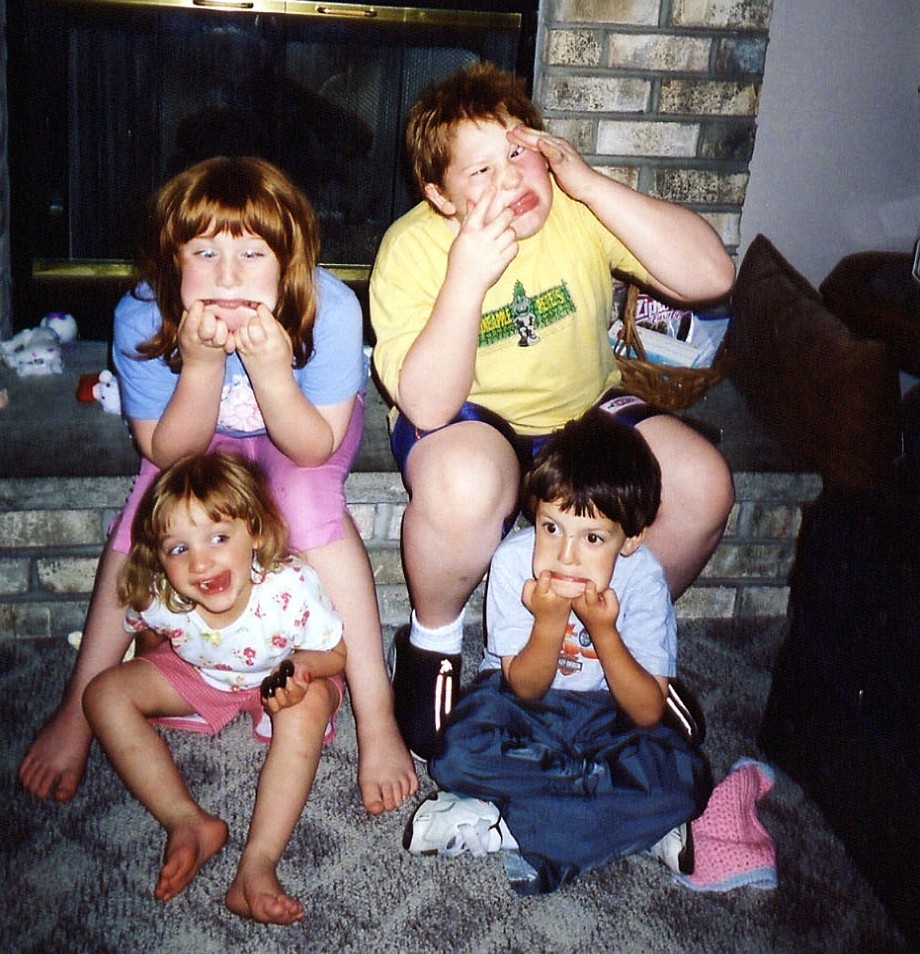
The kids and cousin Geoffrey have a creepy-face contest.
Back down the stairs, I stood in the foyer again. My grandmother’s 1899 Singer sewing machine had been the centerpiece for years as the staging place for all sorts of family displays. I saw the children gathered around the Advent wreath, taking turns lighting the purple and rose candles. Or placing Baby Jesus into the Nativity creche on Christmas Eve. Most of the year it was covered with framed family photos, from the kids’ sports and school pictures to the large wooden-framed antique photo of my Grandma Ruby Hanneman (1904-1977).
I walked into the kitchen and was overwhelmed with memories of family meals, birthday parties, family meetings and prayer time. I recall our weekly ritual of doing a “blessing cup” ceremony, where each of us would take the blessing cup and talk about something we are thankful for. Ruby, who was very young when we started the tradition, always said the same thing: “I’m sankable (thankful) for my skoowa (school).” It never got old. Today, the table is gone and the blessing cup is packed away. I am still most thankful for it all.
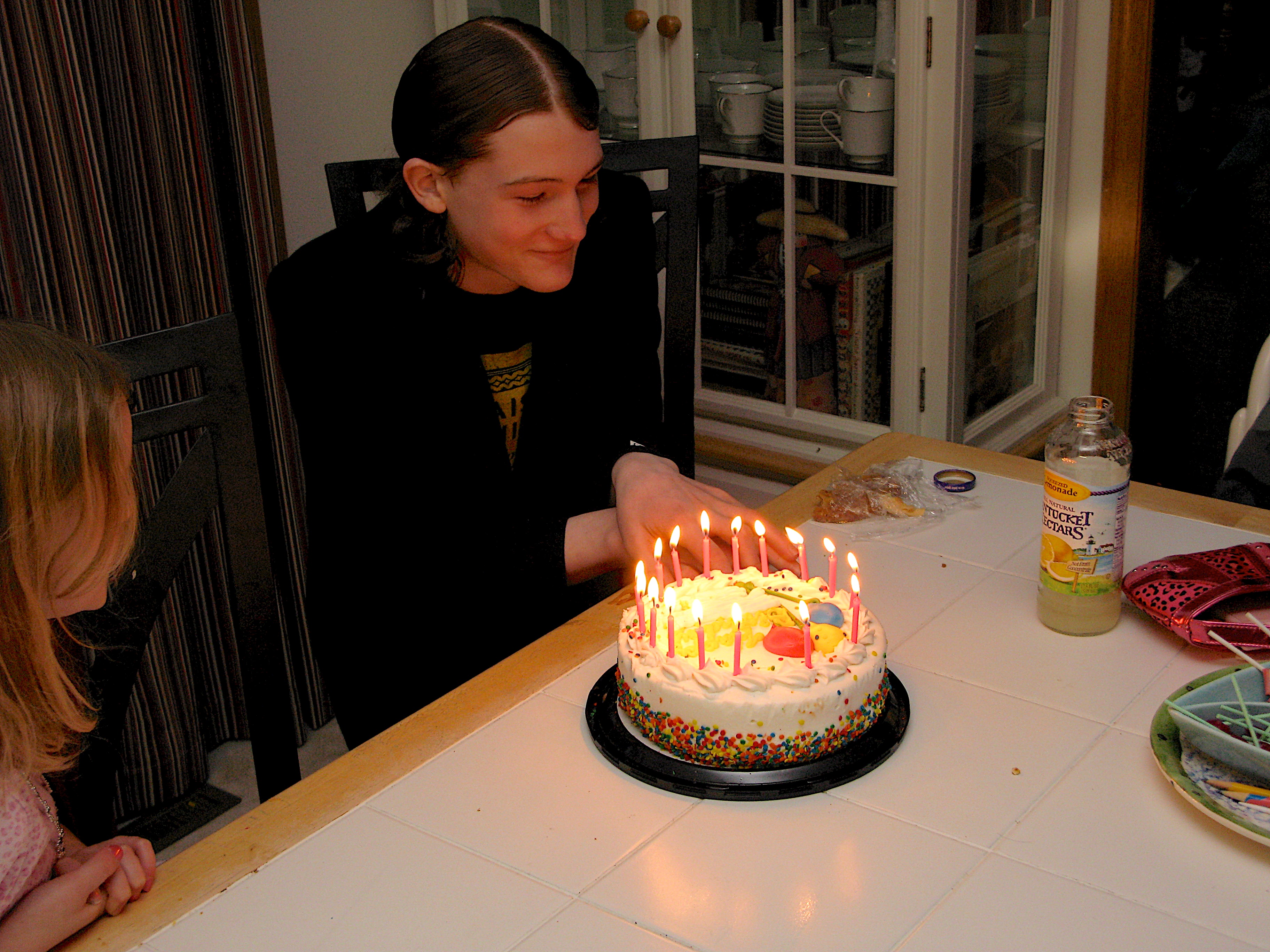
One of many birthdays celebrated at our kitchen table.
I looked out the sliding glass door to the deck. Suddenly the gas grill was fired up and I was cooking steaks, vegetable kabobs and hot dogs. On the corner of the deck, a fire pit crackled with warmth in the fall night, with our children and the neighbors gathered around, toasting marshmallows. A group of children and adults sat in chairs on the deck, watching me light fireworks for July 4th. “Ooh, pretty! Light the big one now, Daddy.” I looked up at the second-story windows and saw the low flickering light from a television playing a favorite Disney movie, Aladdin.
My Dad’s handmade Nativity scene, restored by his granddaughter, Samantha.
I walked around the front of the house and the snow was suddenly 3 feet deep. On the porch was my Dad’s handmade wooden Nativity scene, which daughter Samantha had repainted and restored. It glowed a welcoming gold, red and green in the cold darkness. I walked toward the garage and all three kids came running down the driveway with their fishing poles and a tackle box in tow. “Wait for me!” one yelled, as they ran towards the neighborhood pond. How I miss those fishing days now.
I walked back inside and stood at the foot of the stairway. I listened, but heard nothing. Heavy silence. Nobody home anymore. My heart was so heavy, it felt like stone. I never wanted this day, but now it was here, and at an end. “Thank you so much,” I said out loud, almost expecting the house to answer me. “I’m sorry I failed you. Thank you for sheltering us for so long. I will never forget.” There was one more word I thought I should speak, but the lump in my throat kept it from coming out. I just couldn’t say it.
There was nothing like a lazy Sunday, fishing at the pond.
I pulled out of the driveway for the last time and started to drive away. I stopped and looked out the window. More than a decade of memories were visible to me all at once. They swirled around the house like fairy dust. In the upper window, my oldest daughter laid on her bed, reading a book. On the front lawn, our preschool children splashed in a pool. Relatives filed in the front door with armloads of Christmas presents. Our son sat in a lawn chair on the porch, studying for exams. All three children romped during a nighttime snowstorm. “Dadda, it’s snowing!”A petting zoo was set up in the front yard for a birthday party, with children taking turns riding a pony around the block. A tent was set up for a summertime sleepover. The smell of steaks wafted from the backyard grill. My Dad got out of his blue sedan and walked up the driveway with a wave. Voices rang out from the children’s rooms:“I had a bad dream.” “Santa came!” “I got all As!” “I love you, too.” “I’m really proud of you.”
I rolled down the window and took it all in. I waved and bid all of the memories to come with me. And so they followed. Some things are just too precious to leave behind. ♦
An art project stuck to the sliding glass door.The Christmas tree was always a labor of love.Stevie waits to blow out the candles on his 16th birthday.










 The Hanneman Archive